


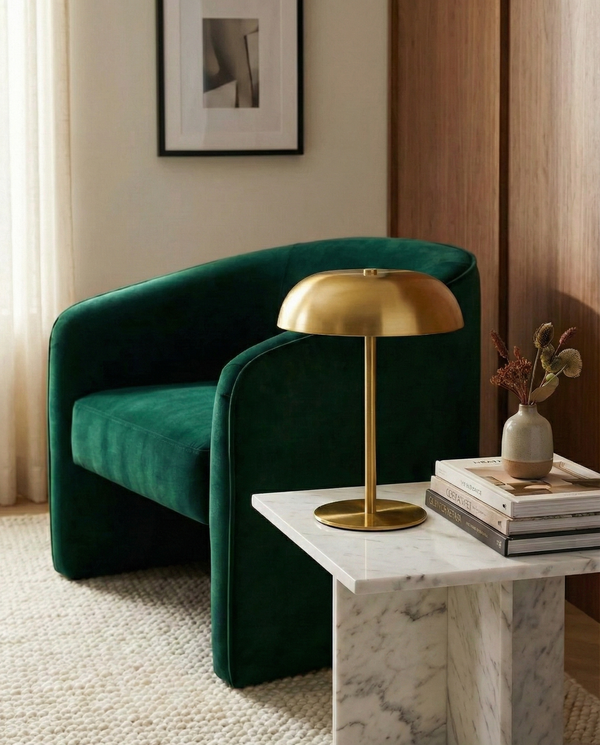

A living room can seem aggressively lit with a single powerful ceiling light, then too dark as soon as it is turned off. Indirect lighting offers another approach: sending light to a surface that softly reflects it into the room. A light-colored wall, a ceiling, or even the inside of a bookshelf becomes a diffuser. There is no need to redo the wiring to try this approach; however, one must consider outlets, lamp stability, and actual uses. Here are six concrete actions, with their limitations, to create a comfortable atmosphere.
This approach complements our guide to layering light sources and our ideas for a cosy living room.
1. Aim a floor lamp at a light-coloured wall
Place a light source near a light-colored wall and direct the beam towards it rather than towards your eyes. The wall reflects diffuse light, less pinpointed than a directly visible bulb. Before buying, test with the lamp you have: move it slightly away from the wall, then observe the size of the light spot from the sofa. A source that is too close sometimes produces a very noticeable circle, more decorative than useful.
The result depends a lot on the color and texture of the wall. A matte white generally reflects more light than a dark blue or an absorbent coating. If your living room is painted in a deep shade, indirect lighting may require another source for circulation. Also avoid placing the beam in front of a painting under glass: the reflection can become as annoying as a bare lamp.
2. Use the ceiling as a broad reflecting surface
A lamp whose light goes up to the ceiling creates a layer of light above people. This solution can make a conversation area more pleasant than a downward beam centered on the coffee table. It is especially suitable if the ceiling is light enough and if there is enough space to place the lamp without obstructing movement. The emitted light does not fully reach the armchairs: do not confuse ambiance with reading light.
Observe the angles of the ceiling. A beam, a cornice, or a slope can create unexpected shadows. In a low living room, a source too close to the ceiling sometimes forms a very bright area instead of even diffusion. Try it at night by sitting in each usual spot. If you can see the bulb from a chair, move or cover the lamp.
3. Light the back of a bookshelf
A small light placed behind a few objects or pointed towards the back of a shelf creates depth without adding a piece of furniture. The principle works best if the light does not shine directly into the eye. Choose a position that keeps the cable out of the area where books are handled and avoids any inappropriate contact with materials sensitive to heat, in accordance with the lamp's instructions.
Do not try to evenly illuminate every shelf. One or two lit levels, surrounded by calmer areas, create a visual rhythm. Light can highlight a ceramic piece, a stack of books, or a textured wood. On the other hand, an entire bookshelf filled with reflective glass is likely to multiply the light points. Move the objects before increasing the power: placement often solves the problem more effectively.
4. Create a halo behind a sofa or an armchair
When the sofa is placed in front of a wall, a light directed towards the back can create a soft background. It visually separates the furniture from the wall and prevents the feeling of a large dark area. For a reading armchair, this halo is particularly pleasant in addition to a light dedicated to the book. It should not replace it: if you read only thanks to the reflection from the wall, your page may remain insufficiently lit.
Measure the available space behind the backrest. Do not trap a lamp or its cable in a space that the manual requires to be left free. Make sure that no one can catch the lamp when getting up and that the wire does not cross the passage. If you do not have enough clearance, place the source next to the furniture or direct it toward a nearby corner; safety and daily use take priority over a photo effect.
5. Make use of an existing wall light
If a wall light is already installed, see how it distributes the light: upwards, downwards, or on the wall. A suitable bulb compatible with the model can change the effect without redoing the installation. Sometimes, simply moving the table or a mirror is enough for the glow to become visible from the sofa. The goal is not to modify an electrical device yourself, but to better utilize the existing light point.
An exposed-source wall lamp does not become indirect just because it is mounted on the wall. Sit in the living room and see if the bulb remains in your field of vision. If it does, choose a shade or a lamp designed to conceal the source, while adhering to the approved installation. Never cover a lamp with fabric or an improvised object: the desired effect does not justify using it against its instructions.
6. Distribute several small sources
Two soft light points, placed at different heights, can structure the living room better than a single strong point. A light reflected off a wall near the sofa and another near a console provide landmarks without making everything uniform. Turn them on separately to observe their contribution. This way, you can keep only one of them on to watch a movie, then add the second when you have friends over.
This method forces you to think about the controls: if three lamps require three complicated gestures, you will quickly return to the ceiling light. A controlled outlet or accessible switches can make usage simpler, provided the electrical characteristics of the devices are respected. For dimmable LEDs, check compatibility before purchase; not all behave well at low intensity.
Keep task lighting and test the result at night
Indirect lighting softens the living room, but reflection on a wall or ceiling consumes part of the light output. Keep a direct solution for tasks that require it: reading small print, playing a board game, arranging furniture, or cleaning. There is no reason to run all lamps at full power all the time. Dividing the roles provides more flexibility than trying to have a single lamp do everything.
Do your test at the time when you actually use the room. An appealing arrangement during the day can become insufficient when the windows no longer contribute. Take photos of several configurations with the same exposure if it helps you compare, but also rely on your eyes and the real tasks. Look at the reflections on the television, the shadows on the table, and how easy it is to move around. Adjust the position first before changing the equipment.
Which idea fits your living room?
| Situation | Gesture to test | Limit to monitor |
|---|---|---|
| Clear free wall | Direct a source toward the wall | Too pronounced stain |
| Light ceiling | Use an uplight | Insufficient to read |
| Library | Illuminate the background of a ray | Cables and reflections |
| Reading corner | Create a halo behind the seat | Add a reading lamp |
This table describes placements, not the guaranteed performance of a model. The result depends on the surfaces, the distance, and the luminaire.
Choosing a lamp based on its diffusion
In our selection, compare thestreetlights and the wall lightsby looking at where the light goes and if the source remains visible from your seats. No decorative lamp is supposed to illuminate all uses of the living room on its own.
Frequently Asked Questions
Is indirect lighting enough for the entire living room?
It can create an atmosphere and facilitate circulation, but a task like reading often requires a well-placed supplementary source.
Should we paint the wall white?
A light-colored wall generally reflects light better, but a colored wall can produce a decorative halo. Test the result before changing the paint.
Can you hide a light bulb behind a fabric?
No, not without explicit indication from the manufacturer. Use a lampshade or a light fixture designed to hide the source, following its instructions.
Which color temperature should be chosen?
A warm light can be suitable for a living room atmosphere, but comfort also depends on the power, diffusion, and other sources present.
Work with surfaces, not just lamps
Wall, ceiling, and furniture can become simple diffusers. First test the direction and visibility of the source, then add a dedicated task light. A comfortable living room combines indirect ambiance and functional points that can be turned on depending on the moment.


