


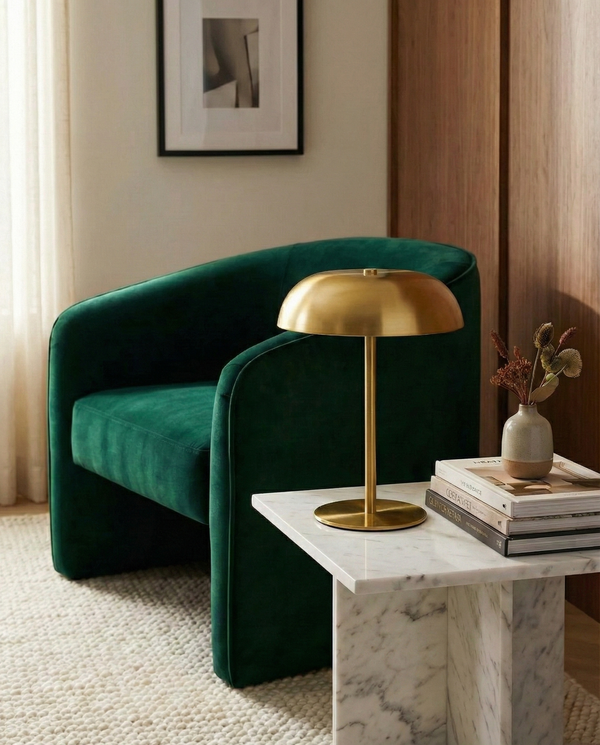

Why does a magazine interior always look warmer, more welcoming, more alive than your own living room? The answer is rarely the furniture or the paint. It is almost always the lighting. And more specifically, the layering of several light sources — what interior architects call "layering".
Looking for the right one? Browse our best-sellers — 8 designs curated by Lumora.
Layering is the art of combining several types of light in the same room to create depth, ambience and functionality. A single ceiling light, however beautiful, will never create this effect. This guide teaches you the exact method used by the professionals — and how to apply it at home on a reasonable budget.
The rule of 3 layers: the foundation of layering
Every professional lighting plan rests on three distinct layers of light. Each has a role, a position and an associated type of light fixture. Excellence in interior lighting is mastery of these three layers and their interaction.
- Layer 1: Ambient light — The general lighting that fills the room with light. It is the base, the backdrop.
- Layer 2: Task lighting — Targeted lighting for activities: reading, cooking, working. It is the spotlight on the actor.
- Layer 3: Accent light — Decorative lighting that highlights an object, a wall, a texture. It is the staging.
The key: each layer must be able to be controlled independently. In the morning, you switch on the task layer (getting ready, working). In the evening, the ambient layer creates the atmosphere. For entertaining, all three layers together — each set to the right intensity — create an interior worthy of a designer.
An interior with a single light source is like an orchestra with a single instrument. Technically, it plays. But it does not create emotion.
Layer 1: ambient lighting — the foundation
Ambient lighting is the general light that fills the room. Without it, the other layers float in the dark. It is the foundation on which everything else rests.
Typical light fixtures
- Uplighter floor lamp — Projects light towards the ceiling, which redistributes it uniformly. Soft, indirect, perfect.
- Wide-diffusion ceiling light — Uniform lighting from above. Choose diffusing models rather than concentrated spotlights.
- Wide-beam wall lights — Wall washing creates a soft ambient light by illuminating the walls.
- LED cornice — Light hidden in a cornice, projected towards the ceiling. The pinnacle of indirect ambience.
Recommended intensity
Ambient lighting should provide around 150 to 300 lux at floor level in a living room. It is not work lighting — it is a comfortable luminous backdrop that allows you to move around, see faces and create an atmosphere. A dimmer is indispensable to adapt the intensity to the time of day.


Layer 2: task lighting — precision
Task lighting is directed at a precise activity zone. It must be powerful enough for the task at hand, without glaring or causing visual fatigue.
Typical light fixtures
- Desk lamp — Adjustable, 500 lux minimum on the work surface
- Bedside lamp / reading lamp — 250-400 lumens for reading in bed
- Rechargeable table lamp — On the dining table to light up dishes and faces
- Spotlights beneath kitchen wall units — Direct lighting of the worktop
- Low pendant light above a table — Targeted lighting of the dining or working surface
The trap to avoid
Task lighting must not be the only source of light in a room. Without an ambient layer, a desk lamp lights your document but leaves the rest of the room in the dark. The contrast is too strong — it is tiring for the eyes and depressing for the mood.
Layer 3: accent lighting — the magic
This is the layer that amateurs systematically forget — and the one that makes all the difference. Accent lighting highlights decorative elements: a painting, a plant, a shelf, a wall texture, an art object.
Typical light fixtures
- Adjustable spotlights — Directed at a painting, a sculpture, a niche
- Decorative wall light — Draws patterns of light on the wall
- Backlighting — LEDs behind a piece of furniture, a mirror, a shelf
- Decorative pendant light — The luminous object itself is the accent
- Decorative table lamp — Placed on a console, a shelf, a side table
The ideal ratio
Accent lighting should be around 3 times more intense than ambient lighting on the targeted area. It is this contrast that creates the "focal point" — your eye is naturally drawn to the brightest areas. Too little contrast and the accent blends into the ambience. Too much contrast and it feels aggressive.


Room-by-room guide: layering in practice
The living room (the most complex room)
- Ambient: Uplighter floor lamp in a corner + possibly wall lights
- Task: Reading lamp next to the armchair + table lamp on the coffee table
- Accent: Spotlight on a painting + backlighting of the TV unit + decorative lamp on the console
The dining room
- Ambient: Wall lights or corner floor lamp
- Task: Pendant light above the table (65-75 cm above) or rechargeable table lamps
- Accent: Spotlights on a sideboard, a dresser or an artwork
The bedroom
- Ambient: Wall lights with an upward beam (no ceiling light)
- Task: Bedside lamps on either side of the bed
- Accent: Backlighting of the headboard + decorative lamp on the chest of drawers
The kitchen
- Ambient: Central ceiling light or recessed spotlights
- Task: LED strips under wall units (worktop)
- Accent: Spotlights in display cabinets, shelf backlighting, decorative pendant light above an island
The most common mistakes in layering
- The single ceiling light — Mistake number one. A single central ceiling light creates flat lighting, without depth or ambience. It is the definition of unlayered lighting.
- Turning everything on at the same intensity — Layering works because there are differences in intensity between the layers. If everything is at maximum, the effect is lost.
- Mixing colour temperatures at random — A 2700K lamp next to a 5000K spotlight creates a visual conflict. Keep a consistency: warm white for ambient and accent, neutral white for task if necessary.
- Forgetting the dimmers — Without a dimmer, you cannot adjust the layers. Layering without a dimmer is like having a piano keyboard without pedals.
- Too many sources — Layering is not 15 lamps in every room. 3 to 5 well-chosen and well-placed sources create a better result than 10 mediocre sources.
How to create your lighting plan
Interior architects follow a precise method. Here is a simplified version you can apply:
Step 1: Identify the activities
For each room, list all the activities: reading, watching TV, eating, working, entertaining, relaxing. Each activity needs its own source of task lighting.
Step 2: Choose the ambient lighting
Determine how to fill the room with light without glaring. An uplighter floor lamp in a corner is often the simplest and most effective solution.
Step 3: Identify the focal points
What do you want to highlight? A painting, a bookcase, a stone wall, a plant? That is where your accent lighting will go.
Step 4: Place the dimmers
Each layer should have its own control. Ideally, one dimmer per layer. At the very least, a dimmer on the ambient layer (the one you will adjust most often).
Step 5: Budget
Split your budget: 40% for ambient, 30% for task, 30% for accent. Ambient is the most important as it is the foundation. Do not skimp on the quality of this first layer.
Our selection by light layer
One light fixture for each layer of perfect layering.
Galora — Wabi-sabi floor lamp, up to 2,000 lumens
A hand-knitted fabric shade on solid wood and forged metal: a sculptural floor lamp giving up to 2,000 lumens, enough to cover 10 to 15 m². E27 LED bulb included.
- Floor lamp
- Hand-knitted fabric
- Up to 2,000 lumens
- For 10-15 m²
- E27 LED bulb included

Verora — Fluted glass and rattan wall light
Our best-selling wall light: finely fluted clear glass on a warm frame, designed like a piece of wall jewellery that creates an intimate atmosphere as night falls.
- Wall light
- Fluted glass
- Rattan
- Grey or gold finish

Belora — Rechargeable touch mushroom lamp
The touch-controlled mushroom lamp: tap the cap to change the intensity and switch between warm, neutral and cool light. Built-in battery, USB cable included.
- Table lamp
- Touch control
- 3 light tones
- Cordless rechargeable
- 8 colours

Sevora — Amber blown glass pendant
Amber blown glass that captures the warmth of a sunset. Mid-Century Modern in spirit, it comes in three shapes (cylinder, oval, sphere) and as a set of 3 for a table or island. E27 fitting.
- Pendant light
- Amber blown glass
- E27 fitting
- 3 shapes or set of 3
Frequently asked questions about lighting layering
How many light sources per room?
The basic rule: minimum 3 sources per living room (one per layer). For a living room, 4 to 6 sources are ideal. For a bedroom, 3 to 4 are enough. For a kitchen, 3 to 5 depending on size. Better a few quality sources than many mediocre ones.
Do you necessarily need a dimmer for every light fixture?
Ideally, yes. At the very least, a dimmer on the ambient layer (the one you will adjust the most). Table lamps with integrated touch-sensitive dimmers simplify matters — no need for an additional wall dimmer.
What budget for complete layering in a living room?
For a well-layered living room: count on approximately €287 to €575 for 4 to 5 quality light fixtures (one floor lamp, two table lamps, one or two wall lights). It is an investment you will keep for 10 years or more.
Can you do layering in a rental property?
Absolutely. Table lamps, floor lamps and rechargeable lamps require no installation. Only wall lights require drilling. You can create excellent layering with 2-3 portable light fixtures, without touching the walls.
Light like a pro
Lighting layering is the most impactful technique you can apply in decoration. Three layers of light — ambient, task, accent — are enough to transform any room into a magazine-worthy space.
Start with the simplest: add an ambient source (uplighter floor lamp) and an accent source (decorative lamp) to your main room. You will be surprised by the transformation.
See the full Lumora collection →
Free shipping to mainland France. Free returns within 30 days. Secure payment.
The Lumora team's view
For complete layering in a living room, our ideal trio: the Galora for ambient (corner uplighter), the Belora for task (coffee table, reading) and the Asiora for accent (highlighting the main wall). Three light fixtures, three layers, a spectacular result.


