


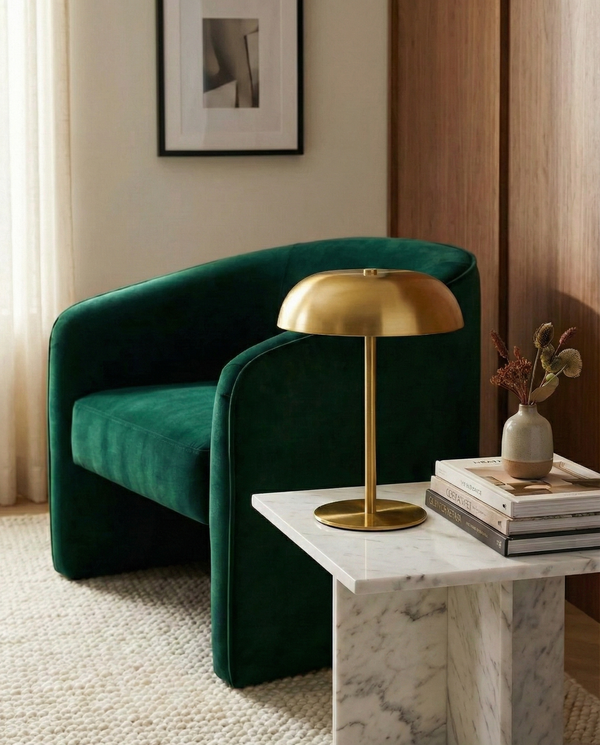

A wabi-sabi lamp is more than a decorative accessory. Its appeal comes from a balance of material, light and empty space: it should add depth without filling the room. A floor lamp in the lounge, a pendant above the table or a soft source beside an armchair all answer different needs. This guide turns an abstract aesthetic into practical buying criteria.
For the background to the look, read our guide to wabi-sabi lighting, then browse the wabi-sabi lamp collection.
Start with function, not shape
In a living room, a wabi-sabi lamp may guide movement, support reading or simply create a quiet focal point. Each role calls for a different format. In a buying guide, this deserves attention before colour or trend: it determines the lamp’s real position, everyday comfort and the coherence of the room. A generous floor lamp suits ambient lighting, while a pendant establishes a visual centre over a table.
Write the primary need in one sentence before comparing models: light the sofa, soften dinner or complete an empty corner. The right choice is therefore not the most spectacular model in isolation, but the one whose material, diffusion and scale answer the room’s needs. This prevents a beautiful sculptural object from becoming irrelevant when light is actually needed.
Living room: choose a vertical presence
A lounge often benefits from a vertical line that balances a sofa and low furniture. A floor lamp provides it without crowding the coffee table. In a buying guide, this deserves attention before colour or trend: it determines the lamp’s real position, everyday comfort and the coherence of the room. Place it slightly behind the sofa or in a corner visible from the entrance so its texture remains legible when switched off.
A wooden base and fabric shade introduce material without adding an aggressive graphic pattern. The right choice is therefore not the most spectacular model in isolation, but the one whose material, diffusion and scale answer the room’s needs. Leave space around it; wabi-sabi works best when each object has room to breathe.
Dining room: frame the table
A pendant is useful when the table lacks a centre or an open room needs visual definition. In a buying guide, this deserves attention before colour or trend: it determines the lamp’s real position, everyday comfort and the coherence of the room. A fabric shade softens the light and makes dinner more intimate, yet it must stay high enough to preserve eye contact and movement.
Choose a diameter in proportion to the table rather than the whole room, then adjust the cable once the furniture is in place. The right choice is therefore not the most spectacular model in isolation, but the one whose material, diffusion and scale answer the room’s needs. One expressive pendant is often enough; too many shapes weaken the calm effect.
Bedroom: prioritise softness
In a bedroom, a wabi-sabi lamp should support a slower rhythm. Diffused light and a matt material matter more than maximum brightness. In a buying guide, this deserves attention before colour or trend: it determines the lamp’s real position, everyday comfort and the coherence of the room. Avoid a bare source in the line of sight from the bed and favour a side glow or indirect light.
Light wood, linen and uneven textures sit naturally with cream, sand, clay and warm grey. The right choice is therefore not the most spectacular model in isolation, but the one whose material, diffusion and scale answer the room’s needs. Keep a separate focused source if you read, because contemplative light is not always sufficient for a practical task.
Materials: welcome variation
The style relies on surfaces that change with the light: visible fibre, wood grain, brushed metal and gently irregular fabric. In a buying guide, this deserves attention before colour or trend: it determines the lamp’s real position, everyday comfort and the coherence of the room. These variations add depth without relying on strong colour.
Study photographs with the lamp switched off as well as on, because the object remains part of the room all day. The right choice is therefore not the most spectacular model in isolation, but the one whose material, diffusion and scale answer the room’s needs. A perfectly smooth, glossy surface will feel more contemporary than wabi-sabi; that is not a flaw, simply a different direction.
Scale without visual clutter
A lamp that is too small disappears, while an oversized volume can visually close the room. In a buying guide, this deserves attention before colour or trend: it determines the lamp’s real position, everyday comfort and the coherence of the room. Use nearby furniture as a reference: a floor lamp relates to the sofa back, a pendant to the tabletop and a small lamp to the surface beneath it.
In a small room, a slender but textured silhouette brings character without dominating. The right choice is therefore not the most spectacular model in isolation, but the one whose material, diffusion and scale answer the room’s needs. In a generous lounge, a larger shade can become the quiet point around which other light sources are organised.
Build layers of light
One lamp should not do everything. Wabi-sabi gains depth when general, task and low-level lighting coexist. In a buying guide, this deserves attention before colour or trend: it determines the lamp’s real position, everyday comfort and the coherence of the room. Pair the main lamp with a discreet source by a wall or chair and use different intensities.
Our guide to layering light sources explains the method room by room. The right choice is therefore not the most spectacular model in isolation, but the one whose material, diffusion and scale answer the room’s needs. Keep the result legible: two or three well-placed sources are better than a scatter of small lamps.
Floor lamp, pendant or table lamp: comparison
| Format | Best use | Effect | Check |
|---|---|---|---|
| Floor lamp | Lounge, reading corner | Vertical structure | Floor space |
| Pendant | Table, room centre | Visual frame | Height and diameter |
| Table lamp | Bedside, console | Intimate glow | Glare |
Format provides the function; material provides the character. Choose in that order for a lamp that is useful as well as beautiful.
Our wabi-sabi selection
These three models cover the main needs: generous living-room light, a fabric pendant and a floor lamp with dual diffusion. The details below come directly from their product pages.

Galora — Wabi-sabi floor lamp, up to 2,000 lumens
A hand-knitted fabric shade on solid wood and forged metal: a sculptural floor lamp giving up to 2,000 lumens, enough to cover 10 to 15 m². E27 LED bulb included.
- Floor lamp
- Hand-knitted fabric
- Up to 2,000 lumens
- For 10-15 m²
- E27 LED bulb included

Sarora — Wabi-sabi pendant, bulb included
A premium fabric shade on a pared-back frame for a soft, enveloping light. E27 LED bulb included (60 to 249 lumens), 150 cm cable adjustable to the height you need.
- Pendant light
- Premium fabric
- E27 LED bulb included
- Adjustable 150 cm cable
- Ø 35 cm

Sabora — Wabi-sabi floor lamp, dual diffusion
A solid wood base with natural grain, brushed nickel finish and a textured fabric shade. 249 to 2,000 lumen LED with dual diffusion, upwards and downwards. 155 cm tall, bulb included.
- Floor lamp
- Solid wood
- 249 to 2,000 lumens
- Up and down diffusion
- Height 155 cm
Frequently asked questions
Which colour suits a wabi-sabi lamp?
Natural tones are easiest to integrate: ecru, sand, wood, warm grey or patinated metal. Texture matters more than the exact colour.
Does wabi-sabi work in a modern interior?
Yes. A single textured piece can soften highly geometric furniture. Give it space and avoid multiplying rustic accessories.
Should the light be very dim?
No. Comfort depends mainly on diffusion and position. A lamp can be generous if the shade conceals the source and spreads the light.
How do I avoid an all-beige room?
Add a restrained contrast such as dark wood, black metal, ceramic or brown textile. Wabi-sabi welcomes nuance rather than uniformity.
Choose a lamp that lets the room breathe
The best purchase answers a clear need while adding a calm material presence. Start with the format, check the diffusion, then choose the texture that speaks to your room. Browse all our wabi-sabi lamps to compare the silhouettes.


