


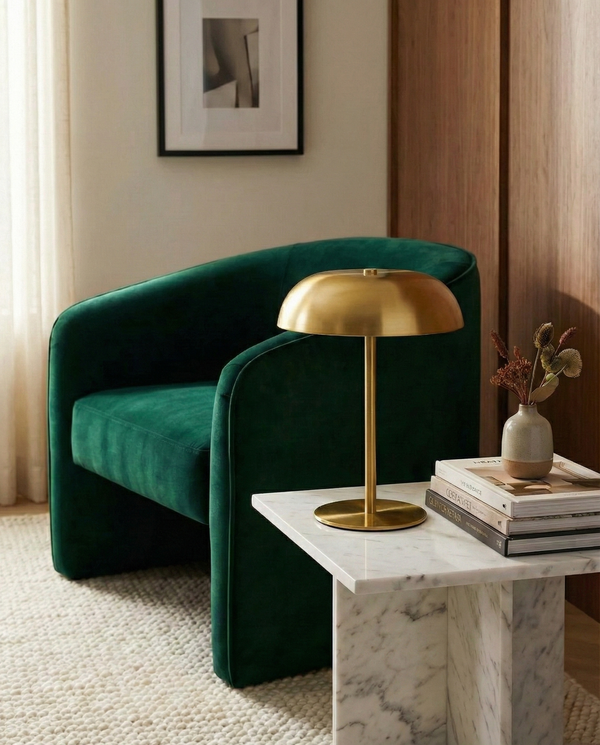

In a world obsessed with perfection — smooth surfaces, millimetre-precise finishes, absolute symmetry — there is a philosophy that celebrates precisely the opposite. Wabi-Sabi is the Japanese art of finding beauty in imperfection, in the ephemeral, in the incomplete. And when this philosophy meets the light fixture, something deeply soothing happens.
Ready to shop? Discover our wabi-sabi lamps — 10 designs curated by Lumora.
In 2026, Wabi-Sabi is one of the strongest lighting trends. Not as a "style" to copy, but as a philosophy that transforms our relationship with objects and with light.
The Wabi-Sabi philosophy: understand before you decorate
Wabi-Sabi has its roots in the Japanese Zen Buddhism of the 15th century. It rests on three fundamental truths:
- Nothing is permanent — Everything changes, everything wears, everything ages. Rather than fighting it, Wabi-Sabi embraces it.
- Nothing is perfect — Irregularity, asymmetry and flaws are the marks of life and authenticity.
- Nothing is complete — There is always space for interpretation, for the imagination, for emptiness.
Wabi and Sabi: two distinct nuances
Wabi evokes rustic simplicity, modesty, the beauty of the spare. It is the wooden hut in the forest, the rough tea bowl, the rice-paper lamp.
Sabi evokes the patina of time, the beauty of wear. It is the wood that greys, the metal that oxidises, the fabric that fades. Sabi tells us that objects gain beauty with age.
Wabi-Sabi does not seek ugliness. It seeks beauty where the Western canon does not see it: in a crack, in an asymmetry, in a knot in the wood. It is a way of seeing, not a style.
Wabi-Sabi and light: a natural pairing
Imperfect light
Wabi-Sabi lighting is never uniform. It is uneven, soft, organic. The light that filters through a rice-paper shade is not the same everywhere — brighter here, fainter there. And that is exactly what makes it alive.
Compare that with a desk LED spotlight: perfect, uniform, constant light. Functional, but soulless. Wabi-Sabi chooses soul.
Shadows as a design element
In the West, we often try to eliminate shadows. In Japanese aesthetics, shadows are a compositional element in their own right. Jun'ichiro Tanizaki described this beautifully in his essay "In Praise of Shadows" (1933): beauty is born in the transition zones between light and shade.
A Wabi-Sabi light fixture plays with shadows. A woven shade casts shadow patterns on the walls. An irregular diffuser creates bright and dark zones that dance subtly. These shadows give the space depth.
The Wabi-Sabi colour temperature
Wabi-Sabi is inseparable from ultra-warm white (2200-2700K). It is the light of oil lamps, candles, twilight. Never cool white, never clinical light. The warmth of the light is the first Wabi-Sabi gesture.


The materials of the Wabi-Sabi light fixture
Rice paper (washi)
The quintessential Wabi-Sabi material. Rice paper is translucent, fragile and ephemeral. It diffuses light with incomparable softness, with a living texture that can be seen by transparency. It is beautiful precisely because it is vulnerable. The Akari lanterns by Isamu Noguchi, design icons, use washi exclusively.
You'll find this same spirit in our Japanese lamps, in rice paper and bamboo.
Bamboo
Each stalk of bamboo is unique: knots spaced differently, variable shade, irregular grain. As bamboo ages, it takes on a golden then brown patina (Sabi). Bamboo light fixtures are often woven or assembled with deliberate variations in spacing.
Raw wood
Not the varnished, sanded wood, but wood that keeps its knots, its cracks, its grain. A lamp base in driftwood is a Wabi-Sabi object par excellence: shaped by water and time, never identical twice.
Linen and woven fibres
Unbleached linen, jute, raw cotton — these rough, irregular fibres filter light and give it a naturally warm tint. Artisanal weaving, with its variations in tension, is a direct expression of Wabi.
Ceramic and terracotta
Light fixtures in ceramic glazed irregularly, with drips and variations in tone, perfectly embody Wabi-Sabi. Each piece bears the trace of the potter's hand and the chance of the firing.
Bringing Wabi-Sabi into a Western interior
Don't change everything at once
Wabi-Sabi is not a "total look" style. It is a gradual infusion. Start with a single light fixture in a natural material — a bamboo floor lamp, a paper pendant light — and observe how it transforms the atmosphere of the room.
Accept emptiness
Wabi-Sabi has a horror of clutter. A Wabi-Sabi light fixture needs space around it to breathe. Don't drown it in a heap of decor. Leave it alone, with emptiness, and it will come fully into its own.
Mix with the modern
Wabi-Sabi pairs beautifully with contemporary minimalism. A living room with white walls and clean-lined furniture gains warmth and character with a natural-fibre floor lamp. The contrast between modern perfection and Wabi imperfection creates a captivating aesthetic tension.
Create a zen atmosphere
For a truly zen ambience, combine a Wabi-Sabi light fixture with:
- Green plants (no cut flowers — too ephemeral in a "frivolous" sense)
- Rough textiles (linen, raw cotton, undyed wool)
- Handmade ceramics
- A palette of earthy colours (off-white, beige, brown, moss green)


Our Wabi-Sabi Lumora selection
Light fixtures that celebrate raw materials, organic forms and the beauty of imperfection.

Japora — Japanese lantern on a wooden base
The Japanese lantern revisited: a twisted shade lined with fine vertical ridges spreads a soft light that ripples across the walls, set on a light wood base.
- Table lamp
- Japanese style
- Light wood base
- Entry price

Sarora — Wabi-sabi pendant, bulb included
A premium fabric shade on a pared-back frame for a soft, enveloping light. E27 LED bulb included (60 to 249 lumens), 150 cm cable adjustable to the height you need.
- Pendant light
- Premium fabric
- E27 LED bulb included
- Adjustable 150 cm cable
- Ø 35 cm

Sabora — Wabi-sabi floor lamp, dual diffusion
A solid wood base with natural grain, brushed nickel finish and a textured fabric shade. 249 to 2,000 lumen LED with dual diffusion, upwards and downwards. 155 cm tall, bulb included.
- Floor lamp
- Solid wood
- 249 to 2,000 lumens
- Up and down diffusion
- Height 155 cm
Also discover the Galora, the Temora, the Timora and the Hitora — all inspired by the Wabi-Sabi aesthetic.
Frequently asked questions about Wabi-Sabi style
Is Wabi-Sabi compatible with a modern interior?
Absolutely. Wabi-Sabi pairs perfectly with contemporary minimalism. A living room with clean lines gains warmth and depth with a light fixture in a natural material. The contrast between modern perfection and Wabi imperfection creates a fascinating harmony.
How do I tell Wabi-Sabi apart from "neglected"?
Wabi-Sabi is an intentional, mastered imperfection. A Wabi-Sabi light fixture is designed with care — the irregularities are part of the design. "Neglected" is a lack of care. The difference: intent. A craftsman who deliberately leaves the knots in the wood visible is making Wabi-Sabi. A maker who delivers a badly finished product is making something shoddy.
Are Wabi-Sabi light fixtures fragile?
Some materials, such as rice paper, are delicate by nature — and that is the point. Awareness of fragility is part of the Wabi-Sabi experience. Bamboo and wood light fixtures, meanwhile, are very hard-wearing. Choose according to your tolerance and way of life.
Where do I buy authentic Wabi-Sabi light fixtures?
Beware of industrial "fake Wabi-Sabi" — mass-produced objects with artificial irregularities. True Wabi-Sabi uses authentic materials worked by hand. At Lumora, our Wabi-Sabi pieces are made with genuine natural materials and an artisan care that respects the philosophy.
Wabi-Sabi: a philosophy, not a fashion
Wabi-Sabi is not a trend that will pass. It is a centuries-old philosophy that answers a deep need of our era: to slow down, to accept imperfection, to find beauty in the simple and the authentic. A Wabi-Sabi light fixture does not decorate your home — it transforms it into a place of peace.
Explore our full collection of light fixtures in natural materials and Japanese-inspired design.
Free shipping to mainland France. Free returns within 30 days. Secure payment.
The Lumora team's view
To start with Wabi-Sabi, the Sabora is our recommendation: its natural fibres and filtered light embody the philosophy effortlessly. For a pendant light, the Zelora and the Sarora bring a magnificent Japanese lantern feel.


