


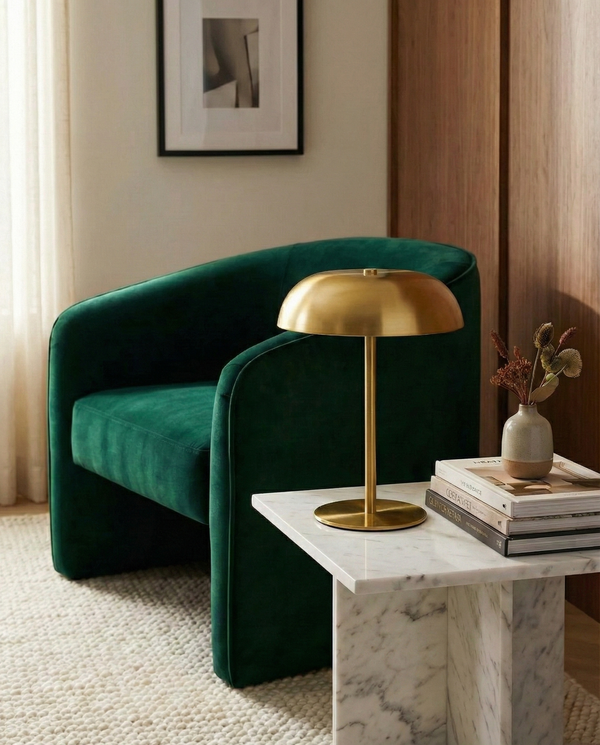

On the packaging, 2700K and 3000K look alike: two "warm whites", 300 kelvins apart. In the room, the difference is real: one is golden and enveloping, the other lighter and easier to see by. Choosing the wrong one does not make the room ugly, but it makes it slightly off its purpose: a living room that feels sleepy, or a bedroom that is not calming enough.
For the full scale, from 2200K to 6500K, read our guide which colour temperature to choose. Here, we settle the two values everyone hesitates between.
2700K and 3000K: the real difference
Colour temperature measures the tint of a white light, in kelvins. The lower the figure, the warmer the light. 2700K is the historic standard for warm white: the light of the old incandescent bulb, golden, slightly orange. 3000K stays in the warm white family but leans a little towards neutral: the light looks whiter and details stand out better.
Side by side, the gap is obvious at once. Separately, most people could not say which of the two is on. That is why the right choice is not made by eye, but according to what you do in the room.
| 2700K | 3000K | |
|---|---|---|
| Tint | Golden, slightly orange | Warm but whiter |
| Reference | Incandescent bulb, distant candle | Halogen, late-afternoon light |
| Feeling | Rest, intimacy | Comfort with visibility |
| Colour rendering | Reds and wood flattered, blues dulled | More faithful, blues less muted |
| In the evening | Ideal before bed | Very good, a notch less soothing |
| For reading or cooking | Adequate, a little weak | Comfortable |
What it changes for sleep
Evening light acts on melatonin, the sleep hormone. A warm 2700K light suppresses only around 15% of it, while a cool light of 5000K and above suppresses 50%. On this point 3000K sits very close to 2700K: both are "evening" lights, light years away from a cool white ceiling light.
So the real rule is not 2700 versus 3000, but switching to warm light 1 to 2 hours before bed, and lowering the intensity. In a bedroom, 2700K remains the safest choice because it leaves no ambiguity: that light does not wake you up.
What it changes for the décor
At 2700K, reds, oranges, wood and warm fabrics are flattered; blues and greys look a little dull. At 3000K, rendering is more faithful: a blue-grey wall or a green sofa keeps its colour. In other words, the cooler or more colourful the décor, the more 3000K respects it; the warmer and more natural it is, the more 2700K flatters it.
2700K stages. 3000K shows. Choose according to what you want the room to do to you: settle you down, or get you going.
The choice room by room
Bedroom: 2700K
In the evening, warm white only, 2700K or below, with a dimmer. This is the room where the gap matters most, because sleep is prepared there. Bedside lamps with several temperatures let you keep a more neutral white for reading, then come back down.
Living room: 3000K, with 2700K accents
For the living room's general lighting, 3000K is the best compromise: warm, but bright enough for everyday activities. Then add warmer accent lamps, 2700K, for the sofa corner and evenings: the ceiling light goes off, the pools of light stay.
Kitchen: 3000K, and more on the worktop
Decorative and ambient light at 3000K; the worktop calls for more precision, between 3000K and 4000K. Here, 2700K would be too soft for chopping and reading a recipe.
Hallway and entrance: 2700K to 3000K
Both work. What matters is matching the entrance to the room it opens onto: if the living room is at 3000K, so is the entrance.
Dining room: 2700K
Dinner is a scene, not a workshop. 2700K flatters faces, dishes and the wood of the table.
Can you mix 2700K and 3000K?
Not on neighbouring sources that light the same surface: two wall lights either side of a mirror, one at 2700K and the other at 3000K, show immediately. On the other hand, a simple rule works well: one temperature for a room's general lighting, and warmer accents where you settle. A 3000K living room with a 2700K reading lamp by the armchair is perfectly coherent.
The most comfortable solution remains a lamp with several colour temperatures: warm in the evening, more neutral when you need to see, without changing the bulb.
Our lamps for switching between the two
Two lamps that change temperature with a touch, and a warm white bulb for your E27 fittings.

Belora — Rechargeable touch mushroom lamp
The touch-controlled mushroom lamp: tap the cap to change the intensity and switch between warm, neutral and cool light. Built-in battery, USB cable included.
- Table lamp
- Touch control
- 3 light tones
- Cordless rechargeable
- 8 colours

Aurora — Cordless lamp, 3,000 to 6,000 K
A 20 cm conical iron silhouette: three light temperatures, from warm white (3,000 K) to cool (6,000 K), and three intensities controlled with a touch. USB charging.
- Table lamp
- Cordless
- 3,000 to 6,000 K
- 3 intensities
- Height 20 cm

E27 8 W LED bulb — warm or cool white
Our E27 LED filament bulb: warm white for a golden, enveloping light, cool white for a more modern mood. Choose when adding to basket.
- LED bulb
- E27 fitting
- 8 W
- Warm or cool white
Frequently asked questions: 2700K or 3000K
2700K or 3000K for a bedroom?
2700K. In the evening the bedroom should be lit in warm white, 2700K or below, with a dimmer. 3000K is still acceptable for reading, provided you come back down to warm before sleeping.
2700K or 3000K for a living room?
3000K for the general lighting, 2700K for the accent lamps in the sofa corner. You keep visibility by day and warmth in the evening.
Is 3000K still a warm white?
Yes. The warm white family runs from 2200K to 3000K. 3000K is its upper limit, a little more neutral than 2700K but with nothing cool about it.
Can you see the difference between 2700K and 3000K?
Side by side, yes, clearly. Separately, hardly. That is why you do not mix the two on neighbouring sources, but you can spread them between general lighting and accents.
Which temperature so as not to disturb sleep?
Warm white, 2700K or below, 1 to 2 hours before bed, at low intensity. A cool light of 5000K and above suppresses around 50% of melatonin, versus 15% for 2700K.
2700K or 3000K, in short
2700K where you rest: bedroom, dining room, sofa corner. 3000K where you live and do things: living room, hallway, kitchen away from the worktop. One temperature per general lighting, warmer accents for the evening, and a dimmer wherever possible. For the rest of the scale, see the full colour temperature guide.
Lumora's advice
If in doubt, pick a lamp with several temperatures. The right value is not the same at 8 am and at 10 pm.


