


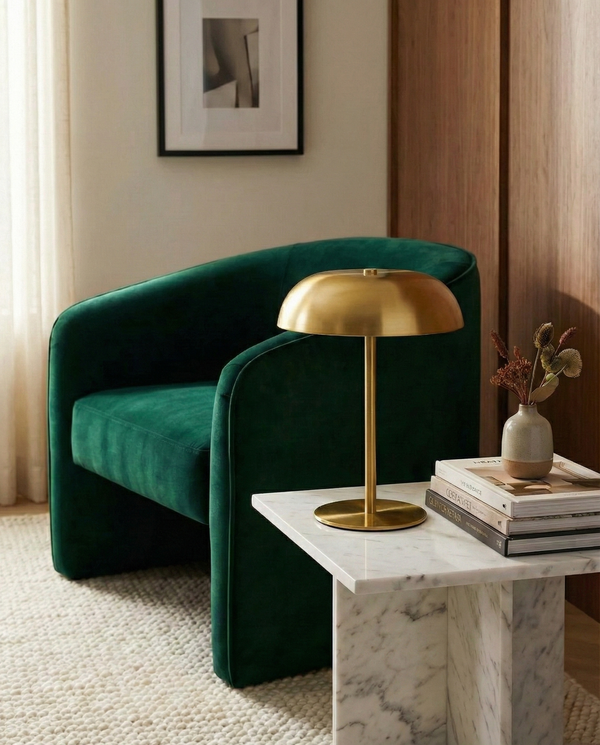

You've bought an LED bulb, installed it, and... the light is cold, bluish, almost harsh. Your living room looks like an open-plan office. And yet the lumens are right, the wattage is appropriate. The problem? You've chosen the wrong colour temperature.
In our shop, explore our best-sellers — 8 designs curated by Lumora.
It is the most overlooked parameter in interior lighting — and yet the most important. It determines whether your room will feel warm or clinical, soothing or stimulating. This guide explains it all.
What is colour temperature?
Colour temperature measures the tint of the white light emitted by a light source. It is expressed in Kelvin (K). Contrary to what one might think, a "warm" temperature corresponds to a low number, and a "cold" temperature to a high number.
The explanation is physical: if you heat a metal, it first glows red (2000K), then becomes orange (3000K), white (5000K) and finally bluish (7000K+). Colour temperature reproduces this spectrum.
The Kelvin scale: from warm to cool
Warm white (2200-3000K)
This is the golden, enveloping light that evokes sunset or candlelight. It creates an atmosphere of relaxation and intimacy. It's the natural choice for rest areas: bedroom, living room, dining room.
- 2200K — very warm, candlelight ambience, perfect for a romantic dinner
- 2700K — the "warm white" standard, the equivalent of the old incandescent bulb
- 3000K — warm but more neutral, a good compromise between comfort and visibility
Neutral white (3500-4500K)
A white light with no warm or cool bias. It offers natural colour rendering and good visibility without tiring the eyes. Ideal for spaces where precise activities take place: kitchen, bathroom, dressing room.
- 3500K — neutral leaning slightly warm, good for the kitchen
- 4000K — the perfect neutral, widely used in offices and for reading
- 4500K — neutral leaning cool, ideal for bathrooms
Cool white (5000-6500K)
A white-to-bluish light, energising and stimulating. It promotes concentration and alertness. It is midday daylight. Use sparingly in a residential setting.
- 5000K — daylight white, good for a workshop or an intensive office
- 6000K — very cool, almost hospital-like rendering in a residential setting
- 6500K — "daylight", used in photography, unsuited to the home


Impact on mood and productivity
Colour temperature is not just a matter of aesthetics. Science has shown that it directly influences our body and mind:
Warm light and melatonin
Warm light (2700K) stimulates the production of melatonin, the sleep hormone. That's why sleep experts recommend switching to warm light at least 1 to 2 hours before bedtime. Cool lighting in the evening disrupts the circadian rhythm.
Cool light and cortisol
Cool light (5000K+) stimulates the production of cortisol, the wake hormone. This is beneficial in the morning or for work, but disastrous in the evening. Studies show a 15% improvement in productivity under 4000-5000K lighting compared with 2700K lighting.
Colour rendering
Colour temperature also affects how we perceive the colours of objects. In warm white, reds and oranges are enhanced, but blues look dull. In cool white, it's the opposite. Neutral white (4000K) offers the best compromise for seeing true colours.
The right colour temperature, room by room
| Room | Ideal temperature | Why |
|---|---|---|
| Bedroom | 2700K | Promotes relaxation and sleep |
| Living room | 2700-3000K | Warm and welcoming ambience |
| Dining room | 2700K | Enhances dishes and creates intimacy |
| Kitchen | 3000-4000K | Good visibility for cooking |
| Bathroom | 3500-4000K | Natural rendering for make-up |
| Office | 4000-5000K | Concentration and productivity |
| Corridor | 3000K | Gentle transition between rooms |
The golden rule: the closer you are to bedtime, the warmer the light should be. And the more concentration an activity requires, the more neutral or cool the light can be.


Our lamps with adjustable temperatures
To never go wrong, choose a lamp that offers several colour temperatures. A single touch is enough to switch from warm white to neutral.
Belora — Rechargeable touch mushroom lamp
The touch-controlled mushroom lamp: tap the cap to change the intensity and switch between warm, neutral and cool light. Built-in battery, USB cable included.
- Table lamp
- Touch control
- 3 light tones
- Cordless rechargeable
- 8 colours

Aurora — Cordless lamp, 3,000 to 6,000 K
A 20 cm conical iron silhouette: three light temperatures, from warm white (3,000 K) to cool (6,000 K), and three intensities controlled with a touch. USB charging.
- Table lamp
- Cordless
- 3,000 to 6,000 K
- 3 intensities
- Height 20 cm

E27 8 W LED bulb — warm or cool white
Our E27 LED filament bulb: warm white for a golden, enveloping light, cool white for a more modern mood. Choose when adding to basket.
- LED bulb
- E27 fitting
- 8 W
- Warm or cool white
Frequently asked questions about colour temperature
3000K or 4000K for the living room?
For the living room, 3000K is the best choice. It offers a warm, welcoming white while still being bright enough for everyday activities. 4000K is better suited to workspaces — it is too "cool" for a cosy living room ambience in the evening.
Can temperatures be mixed in the same room?
Yes, but methodically. The general lighting should be the same temperature. Then you can add accents at a different temperature: for example, general lighting at 3000K with a reading light at 4000K for reading. Avoid mixing 2700K and 6000K — the contrast is too jarring.
Does colour temperature affect sleep?
Absolutely. Scientific studies show that exposure to cool light (5000K+) in the evening suppresses melatonin production by 50%. Switch to warm white (2700K) at least 1 to 2 hours before bedtime for optimum sleep onset.
How do I check the colour temperature of a bulb?
It is always shown on the packaging in Kelvin (K). On LED bulbs, look for the pictogram with a colour scale. If you are unsure about your current bulbs, smartphone light-measurement apps give a fairly reliable estimate.
The right colour makes all the difference
Colour temperature is the secret of interiors that "feel good". Two living rooms with identical furniture can have radically different atmospheres simply because of the tint of the light. Now that you know the rules, you will never look at your bulbs the same way again.
See the full Lumora collection →
Free shipping to mainland France. Free returns within 30 days. Secure payment.
The Lumora team's view
Our recommendation: always choose a lamp with at least 3 colour temperatures. This is the case with all our Lumora lamps. You don't yet know how you will use your lamp — better to have the choice than to regret a tint that is too cool or too warm.


