


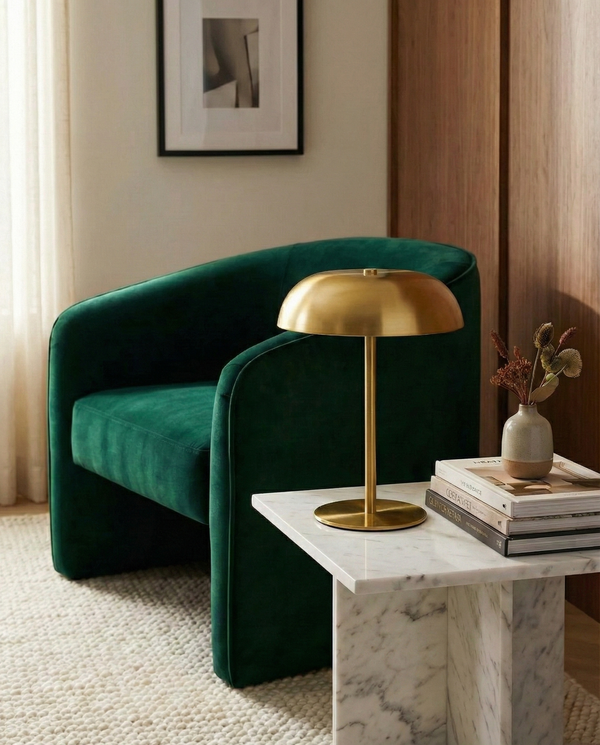

Five years ago, a rechargeable lamp was a gadget. Today, it has become the standard of the market. And for good reason: who still wants a cable trailing across the bedside table, the dinner table or the terrace?
Want to go further? Discover our table lamps — 21 designs curated by Lumora.
The cordless rechargeable lamp has revolutionised our relationship with accent lighting. No more socket constraints, no more unsightly cable, no more cluttered bedside table. But not all rechargeable lamps are created equal — far from it. This guide explains how to choose the right one.
Why the cordless lamp changed everything
Wired lighting imposes a simple but tiresome constraint: your lamp is chained to a socket. That means you have to arrange your furniture around the sockets, hide the cables, and give up lighting places without electrical access.
The rechargeable lamp does away with all that. Here is what it changes in concrete terms:
- Freedom of placement — put it wherever you want, move it whenever you want, take it from one room to another
- A tidy bedside table — no more cable tangled up with the phone charger
- Outdoor use — terrace, balcony, garden, camping... the light follows you everywhere
- Candlelit dinner 2.0 — a rechargeable lamp in the middle of the table elegantly replaces candles
- Safety — no cable to trip over, no overloaded socket
The cordless lamp is not a compromise. With modern batteries and low-consumption LEDs, it is a genuine improvement over wired lighting for all accent uses.
How the battery works: what you need to know
Li-ion technology
Almost all quality rechargeable lamps use lithium-ion (Li-ion) batteries, the same technology as your smartphone. Why? Because Li-ion offers the best compromise between capacity, weight and lifespan.
Key characteristics of Li-ion:
- 500 to 1,000 charge cycles before significant degradation
- No memory effect — you can recharge at any level without damaging the battery
- Low self-discharge — the lamp keeps its charge for weeks if you are not using it
- Reduced weight — important for a portable lamp
Runtime: the real figures
Manufacturers often advertise the runtime at minimum intensity. When you read "up to 48h of runtime", it is probably at 10% brightness — a night light, not functional lighting.
In real use (medium intensity), divide by 2 to 3. Here are some honest benchmarks:
- 6-8 hours at medium intensity — the acceptable minimum
- 10-12 hours at medium intensity — excellent, you can last a whole evening
- 15+ hours — top of the range, perfect for intensive daily use


The 5 essential criteria for choosing well
1. Real runtime
As explained above, look at the runtime at medium intensity, not maximum. A minimum of 8 hours is necessary for comfortable use. If you use your lamp as a bedside lamp every evening, aim for 10+ hours so you don't have to recharge it daily.
2. Type of charging: USB-C mandatory
In 2026, there is no more excuse for micro-USB. USB-C is the universal standard: you use the same cable for your lamp, your phone and your laptop. Some models even offer wireless charging (Qi) — convenient, but slower.
3. The IP protection rating
If you plan to use your lamp outdoors, it is THE non-negotiable criterion:
- IP20 — indoor use only
- IP44 — protected against splashes, for use on a covered terrace
- IP54 — protected against dust and water splashes, open terrace
- IP65 — fully dust-tight, resistant to water jets
4. Weight and bulk
A portable lamp has to stay... portable. Aim for a weight between 300 and 600 g for a compact format. Beyond a kilo, you won't want to move it — and it loses its main appeal.
5. Lighting modes
The minimum: 3 intensity levels and ideally 3 colour temperatures. That is what makes the difference between a lamp that does everything and a lamp that only serves one purpose. Colour temperature is crucial for ambience.


Indoor vs outdoor: what changes
Indoors
Design comes first. The IP rating is secondary (IP20 is enough). Runtime can be shorter as you always have a socket nearby to recharge. Focus on aesthetics, light quality and touch-sensitive control.
Outdoors
Priorities change: IP54 minimum, long runtime (10h+), UV resistance (plastic yellows in the sun), and ideally a weighted base to resist the wind. The mushroom lamp is particularly well suited thanks to its low centre of gravity.
Battery care and longevity
A few simple rules to maximise lifespan:
- Avoid leaving the battery at 0% for long periods — recharge before it runs completely flat
- Do not store in direct sunlight — heat degrades Li-ion cells
- Recharge between 20% and 80% to maximise cycles — no need to always go to 100%
- Use the original cable or a quality USB-C cable
Our selection of Lumora cordless lamps
Three rechargeable, touch-controlled models at gentle prices.

Carora — Cordless mushroom lamp, 3 intensities
The iconic mushroom lamp in a touch-sensitive, cordless version: tap the top to switch on, three intensities (dim, reading, bright), USB-C charging and a matte finish. Cable included.
- Table lamp
- Touch activation
- 3 intensities
- USB-C rechargeable
- 4 colours

Aurora — Cordless lamp, 3,000 to 6,000 K
A 20 cm conical iron silhouette: three light temperatures, from warm white (3,000 K) to cool (6,000 K), and three intensities controlled with a touch. USB charging.
- Table lamp
- Cordless
- 3,000 to 6,000 K
- 3 intensities
- Height 20 cm

Velora — Slender mushroom lamp, 3 temperatures
The mushroom lamp in a slender silhouette: three colour temperatures, intensity adjusted with a touch, USB-C charging with no visible cable. Cable included.
- Table lamp
- 3 colour temperatures
- Variable intensity
- USB-C rechargeable
- Orange finish


Frequently asked questions about cordless lamps
How long does the battery of a rechargeable lamp last?
In real use (medium intensity), count on between 6 and 12 hours depending on the model. The Carora lasts up to 12 hours, the Noara up to 10 hours. At minimum intensity, the figures can double.
Can you use a rechargeable lamp while leaving it plugged in?
Yes, most modern lamps have a protection circuit that stops charging once the battery is full. You can therefore use it plugged in like a classic wired lamp, and unplug it when you want to move it.
What is the battery's lifespan?
A quality Li-ion battery retains 80% of its capacity after 500 charge cycles. Recharging every 2-3 days, that represents 3 to 4 years of optimal use. The battery continues to work after that, with a progressively reduced runtime.
Are cordless lamps as bright as wired ones?
For accent lamps (200-400 lumens), yes, absolutely. LEDs consume so little that a small battery is enough. On the other hand, for main lighting (1000+ lumens), wired remains preferable as the battery would drain too quickly.
Cordless means freedom
The rechargeable lamp has done away with the last constraint of accent lighting: the cable. Whether for your bedside table, your terrace dinner or your evening in the garden, it offers you total freedom of placement and movement.
The only real piece of advice: choose a USB-C model with at least 8 hours of runtime. Below that, you will spend more time recharging than enjoying your lamp.
See the full Lumora collection →
Free shipping to mainland France. Free returns within 30 days. Secure payment.
The Lumora team's view
For mainly outdoor use (terrace, garden), the Carora IP54 is unbeatable. For indoor use where design comes first, the Noara mirror chrome is our favourite. Both charge via USB-C and last a whole evening.


