


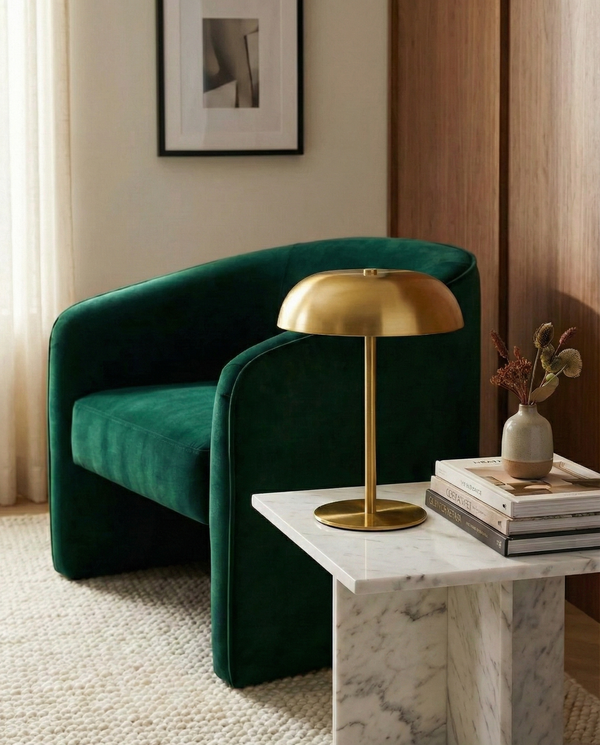

A sideboard can become the calm focal point of a lounge or a shelf where objects gather without order. A table lamp changes how the furniture reads: it adds height, draws the eye towards artwork and creates low-level light in the evening. For it to work, judge two scenes: daytime with the lamp off and evening with it on. The furniture's size, the available socket and neighbouring objects matter as much as the lamp itself.
To build layers of light, read our guide to layering light sources and our ideas for a cosy lounge atmosphere.
Measure the furniture and wall together
The sideboard's width alone is not enough. Look at the free wall above it and what occupies that space: mirror, picture, shelf or nothing. A small lamp can disappear beneath large artwork; a tall silhouette can cover part of a frame. Set an object of similar volume in the proposed place before deciding.
Leave room for ordinary actions: opening a drawer, putting down a tray and wiping the surface. A lamp placed at the edge of a cabinet door will be moved repeatedly. On a shallow console, measure the base and cable position above all. The object needs to stand securely, not merely look good from the front.
Create a centre or an off-centre balance
A lamp exactly in the middle can work on a short, nearly empty piece of furniture. On a long sideboard, a slightly off-centre position often makes a more relaxed arrangement. Pair it with two lower objects, perhaps a book and a vase, leaving some open surface between groups. The aim is a legible silhouette, not a crowded line.
View the composition from the entrance and from the sofa. An arrangement that works head-on may seem pushed against the wall from the angle where you actually live. If the sideboard already holds many objects, begin by removing rather than adding. A lamp needs some visual space behind it to have presence.
Opal glass for confident colour
Spimora has a red loop-shaped metal base and an opal-glass globe. Its page lists a compact height of 22 cm. It is a graphic piece that attracts attention even when switched off. On a light or dark wooden sideboard, it can provide a single useful colour accent.
The opal globe softens the source and suits low ambient light in a lounge. If a colourful picture already hangs above the furniture, see whether the red echoes a detail or competes with it. One quiet connection is better than gathering multiple red accessories around the lamp.
Frosted glass for a taller volume
Felora stands 47 cm high according to its page, with a 28 cm frosted-glass shade and a base 20 cm across. That scale occupies more of the wall and can balance a large mirror or generous sideboard. It comes in several colour combinations with either a gold or silver structure.
Its frosted glass gives a more diffused glow than a bare source and makes the object present without exposing the bulb. Check the furniture depth and mirror position, however. A large lamp can create a pleasing reflection, but it can also double an already oversized volume in a narrow room.
Fabric and wood for a quieter presence
Japora pairs a beige twisted-effect fabric shade with a light wooden base. Its listed height is 32 cm. The vertical texture animates the object without strong colour, which can suit a sideboard whose wood or ceramics already bring character.
The fabric softens the light and gives a calmer glow than an exposed source. Study the lamp while off too. If furniture, wall and shade are all the same beige, the arrangement may lack definition. A dark frame, a small clay object or a plant can provide enough contrast without breaking the natural mood.
Test the mirror and artwork
A mirror above the sideboard visually multiplies light sources, but may also reveal the bulb from the sofa. Sit in the usual places and check the reflection before settling the composition. A diffusing shade is often easier to live with here than a source directly visible to the eye.
With artwork, the lamp does not replace a light aimed at the picture. It mainly illuminates the furniture and creates a low pool that draws the eye towards the wall. Do not press it against the frame: a little space lets both silhouettes read clearly and makes cleaning easier.
Remember cable and care
Spimora, Felora and Japora are wired lamps according to their pages. Before placing them on a central console or away from a wall, check the route to a socket. A lead stretched across circulation quickly spoils the arrangement and becomes inconvenient. A nearby socket or a discreet route behind the furniture makes daily use simpler.
Materials also change cleaning. Opal and frosted glass are dusted differently from a fabric shade; a metal base may show fingerprints more readily. Consider who uses the furniture and how often it is cleaned. The ideal lamp stays appealing without a daily styling ritual.
Three silhouettes for a sideboard
| Model | Presence when off | Plan for |
|---|---|---|
| Red opal globe | Small graphic accent | Neighbouring colours |
| Tall frosted glass | Sculptural volume | Furniture depth and mirror |
| Beige fabric and wood | Quiet natural texture | Contrast with the wall |
Choose the silhouette with the lamp off, then check its reflection and glow once switched on.
Three table lamps to compare
The following models are active. Dimensions, materials and power methods come from the product pages checked today.

Spimora — red opal globe
A loop-shaped red metal base and opal-glass globe. Its page lists a height of 22 cm, a diameter of 12 cm and wired power.
- 22 cm high
- Opal glass
- Wired power

Felora — frosted glass
A 47 cm table lamp with frosted-glass shade. Available in several colour combinations, it is mains-powered.
- 47 cm high
- Frosted glass
- Cable included

Japora — fabric and wood
A 32 cm Japanese-style lamp with beige fabric shade and light wood base. Wired power provides continuous light.
- 32 cm high
- Fabric shade
- Light wooden base
Frequently asked questions
Must the lamp stand in the middle of the sideboard?
Not necessarily. On a long piece, an off-centre position often leaves room for a balanced composition. View the result from the entrance and sofa.
Can a sideboard lamp light the whole lounge?
It mainly creates low-level light and ambience. Combine it with sources suited to circulation, reading and dining where those tasks take place.
Which model works beneath a large mirror?
Compare lamp height and furniture depth, then test the reflection from the seats. A taller volume may balance the mirror, but should neither block the view nor glare.
How can I hide the lead on a console?
Place the console near a socket and route the cable behind the furniture according to the product instructions. Avoid any wire stretched across a walking route.
Decorate with light you will actually use
A small coloured lamp adds an accent, a larger frosted-glass form brings volume and a fabric shade calms the arrangement. Measure the furniture and wall first, then check cable and reflections. Browse our table lamps for a silhouette that fits your lounge.


