


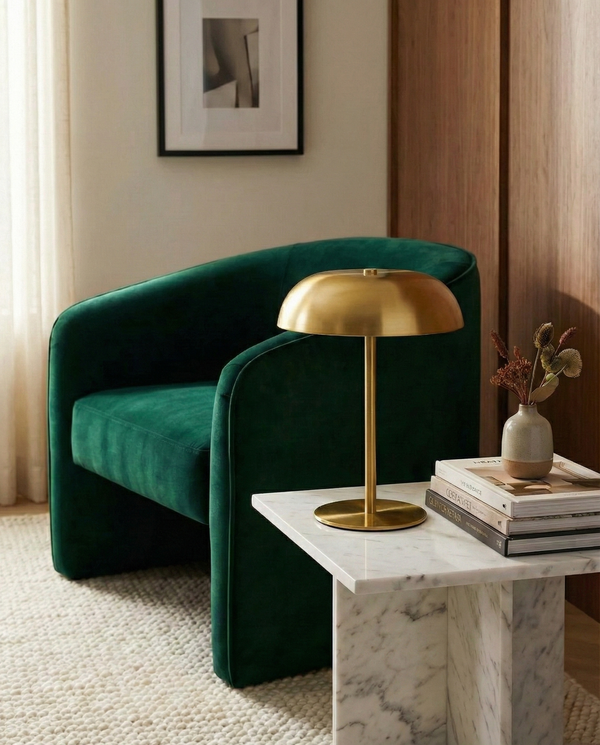

Your bedroom is the last space you see before sleeping and the first you see upon waking. Lighting plays a far deeper role here than in any other room: it directly influences the quality of your sleep, your circadian rhythm and your general well-being.
Want to go further? Discover our table lamps — 21 designs curated by Lumora.
Poorly planned bedroom lighting can literally prevent you from sleeping well. Conversely, suitable lighting transforms your bedroom into a sanctuary of rest.
The science of sleep and light
Melatonin: the hormone that light controls
Melatonin is the hormone that regulates your sleep-wake cycle. Its production is directly controlled by the light received by your eyes. When light decreases, the brain increases melatonin production — you become drowsy. When light is strong, production stops — you are awake.
The problem: blue and cool light (5000K+) suppresses melatonin particularly effectively. That's the light of our screens, our cool-white LEDs, our standard ceiling lights. By exposing yourself to this light in the evening, you're telling your brain: "it's noon, stay awake".
The numbers that speak
- A 2-hour exposure to cool light (5000K) in the evening delays melatonin production by 90 minutes
- Warm light (2700K) only suppresses 15% of melatonin, compared with 50% for cool light
- Intensity matters too: above 100 lux in the evening, melatonin begins to be affected
Your bedroom should be lit exclusively in warm white (2700K or less) in the evening. It's the simplest and most effective change to improve your sleep.
The 3 ideal layers of bedroom lighting
1. General lighting — soft and indirect
The bedroom ceiling light should never be used in the evening. Its role: lighting the room when you get dressed, do housework or look for something. Opt for a pendant light with a dimmer or spotlights angled toward the ceiling for soft, bounced light.
Recommendation: 100 to 200 lux for general lighting, always in warm white (2700-3000K).
2. Task lighting — bedside lamps
This is the most important lighting in the bedroom. Your bedside lamps must offer enough light to read (300-400 lux on the book) without dazzling the person next to you.
Essential criteria: dimmer, warm colour temperature (2700K ideally), placement at eye level when sitting.
3. Ambient lighting — the finishing touch
This is what transforms a functional bedroom into a refuge. A few ideas:
- Wall lights on either side of the bed — soft indirect light upward
- LED strip under the bed or behind the headboard — spectacular floating effect
- Ambient lamp on the chest of drawers — warm point of light that creates depth


Properly placing your bedside lamp: the pro rules
Bedside lamp placement follows precise rules:
- Height — the lower edge of the shade should be at eye level when sitting up in bed (50-60 cm above the mattress)
- Distance from the bed — the edge of the lamp 15-20 cm from the edge of the bed, accessible without leaning
- Accessible control — a touch-sensitive lamp is ideal because you don't have to search for a button in the dark
- Symmetry — for a couple, two identical (or complementary) lamps create a restful visual balance
Why the dimmer is essential in the bedroom
The dimmer is the essential tool of bedroom lighting. Without it, your bedside lamp has only two options: full power or off. With a dimmer:
- 9pm — medium intensity (50%) to read or chat
- 10pm — low intensity (20%) for the transition to sleep
- 11pm — minimum intensity (5%) as a night light, just enough to find your way
This gradual decrease of light mimics sunset and helps your brain produce melatonin naturally. It's the best natural sleeping aid there is.
Lighting the children's bedroom
Children have specific lighting needs:
- Mandatory night light for little ones — a lamp with dimming set to minimum is ideal (no blue or green night light, only warm white or amber)
- Stronger light for playing — children need more lumens than adults for creative activities (300-500 lux)
- Safety first — no accessible cable, no lamp that heats up, no removable parts. Wireless LED lamps are the safest choice
- Evening routine — gradually dimming the light 30 minutes before bedtime creates a strong signal for the child's brain


Our selection for the bedroom
Light fixtures designed for well-being and night-time comfort.

Belora — Rechargeable touch mushroom lamp
The touch-controlled mushroom lamp: tap the cap to change the intensity and switch between warm, neutral and cool light. Built-in battery, USB cable included.
- Table lamp
- Touch control
- 3 light tones
- Cordless rechargeable
- 8 colours
Aurora — Cordless lamp, 3,000 to 6,000 K
A 20 cm conical iron silhouette: three light temperatures, from warm white (3,000 K) to cool (6,000 K), and three intensities controlled with a touch. USB charging.
- Table lamp
- Cordless
- 3,000 to 6,000 K
- 3 intensities
- Height 20 cm

Asiora — Textured wall light with a natural feel
A wall light with an organic texture that breaks the coldness of plain walls and gives the room a warm presence, somewhere between natural craft and contemporary design.
- Wall light
- Natural texture
- Metal and glass
- Beige finish
Frequently asked questions about bedroom lighting
Which colour temperature for sleeping?
In the evening, use only warm white (2700K or less). Cool temperatures (5000K+) suppress melatonin and delay falling asleep by 60 to 90 minutes. Ideally: switch to 2700K at least 1 hour before bedtime.
Do I need a ceiling light in the bedroom?
It's useful but not essential. Many luxury hotel rooms have no ceiling light — only bedside lamps and wall lights. If you have a ceiling light, use it rarely and always with a dimmer. Your main evening lighting should be your bedside lamps.
How do you read in bed without disturbing your partner?
Choose a bedside lamp with a beam directed downward (not diffused light throughout the room). Lamps with an opaque shade on the sides and open at the bottom are perfect. Set the intensity to 30-40% — enough to read, discreet for the person next to you.
Do screens really disturb sleep?
Yes, it's proven. Screens emit a lot of blue light (6500K+). Even with night mode activated, the brightness remains too high. Ideally: no screens 30 minutes before bedtime, and replace them with reading under the warm light of your bedside lamp.
Sleeping better starts with better lighting
Bedroom lighting isn't a secondary matter — it's a health issue. Suitable lighting can significantly improve the quality of your sleep, your energy and your mood. The changes to make are simple: warm white, dimmer, no screens. Your body will thank you.
See the full Lumora collection →
Free shipping to mainland France. Free returns within 30 days. Secure payment.
The Lumora team's verdict
For the bedroom, our ideal combination: two Belora as bedside lamps (warm white, touch-sensitive dimming) and a pair of Asiora as wall lights for the ambience. The result: lighting worthy of a 5-star hotel, without a ceiling light.


