


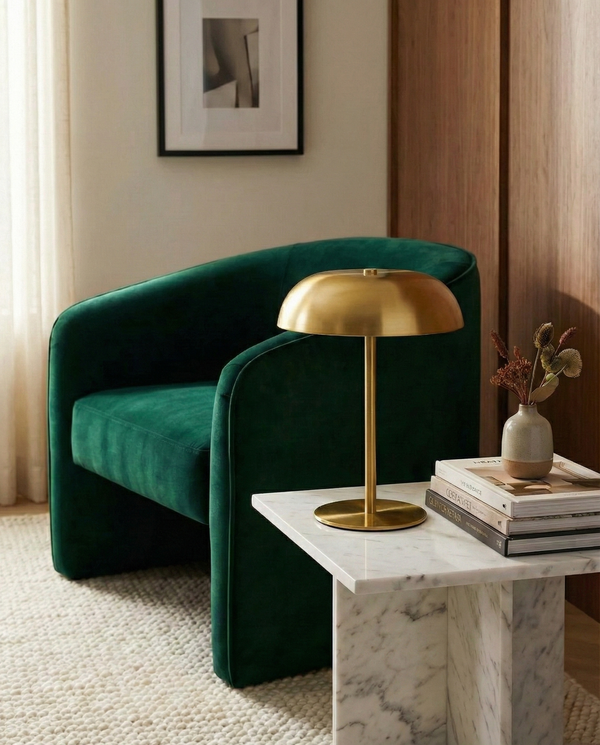

Living in 30 m2? A narrow corridor? A bedroom in the eaves? Before knocking down walls, try light. Well-thought-out lighting can make a room appear up to 30% larger than it really is. No magic — just optical physics and a few design principles.
Ready to shop? Discover our best-sellers — 8 designs curated by Lumora.
Interior architects know it well: perception of space depends more on light than on square metres. A large dark flat feels cramped. A small, well-lit studio feels spacious. This guide gives you the keys to harness this phenomenon in every room of your home.
The optical illusions created by light
Our brain assesses the size of a space based on visual cues: contrasts, shadows, the brightness of surfaces and perceived depth. Light acts directly on all these cues.
Bright surfaces = perceived space
A well-lit surface appears to recede. That's why a white wall lit up seems further away than a dark wall in shadow. By lighting the peripheral walls of a room (wall washing), you create the illusion that the walls recede — and that the room is larger.
Shadows shrink
Shaded zones create an invisible "wall" effect that reduces perceived space. A dark corner in a living room gives the impression that the room ends there. By lighting the corners and nooks, you visually reclaim those lost square metres.
Uniformity enlarges
Uniform lighting (without pronounced shadow zones) gives the impression of a continuous, open space. Conversely, heavily contrasted lighting (a single central spot, everything else in shadow) visually compartmentalises the room and makes it appear smaller.
The rule is simple: the more evenly light is distributed, the larger the room appears. Multiply the sources, eliminate the shadows.
Direction of light: the vertical trick
Vertical light = higher ceiling
A light beam projected upwards (uplighting) draws the eye towards the ceiling and gives the impression that it is higher. It's the most effective trick for rooms with a low ceiling (under 2.40 m). A wall light with an upward-facing beam or an uplighter floor lamp can work miracles.
Horizontal light = wider room
Wall lights placed on the long walls of a narrow corridor project light horizontally and visually widen the passage. Horizontal wall washing is the most effective technique for long spaces.
Downward light = crushing the space
Be wary of recessed spots that project only downwards. They create cones of light on the floor and leave walls and ceiling in shadow. Result: the room appears lower and narrower. It's the most common mistake in small spaces.


The magical duo: mirror + light
The mirror is light's best ally for enlarging a space. The combination of the two creates spectacular effects.
Mirror facing the window
A classic but formidable trick: a large mirror placed opposite the window doubles the natural light and creates a false sense of depth. The room appears instantly twice as large.
Mirror + table lamp
Place a table lamp in front of a mirror. The light is reflected and redistributed around the room. Double effect: more light and more depth.
Mirror + wall light
In a narrow corridor, place a mirror on a long wall with a wall light on either side. The wall lights illuminate the mirror, which reflects the light and the opposite wall. The corridor appears twice as wide.
The mistake to avoid
Never place a mirror opposite a dark or cluttered wall. It will reflect the mess or darkness and reinforce the feeling of narrowness instead of easing it.
Which type of light fixture for small spaces?
Wall lights: the best choice
The wall light is the queen of small spaces. It takes no floor space, it lights the walls (wall washing) and it can project upwards to lift the ceiling. Two wall lights are enough to transform a narrow corridor into an elegant passageway.
Recessed or flush ceiling lights: yes but...
Flush ceiling lights (mounted against the ceiling) are ideal for low ceilings because they don't take up any height. But choose models with wide diffusion rather than directional spots. A ceiling light that illuminates the ceiling as much as the floor is more effective than a concentrated spot.
Pendant lights: handle with care
In a small space, a pendant light hung too low eats into the visual space. If you opt for a pendant light, keep it short (30-40 cm below the ceiling) and choose a transparent or airy model that doesn't block the line of sight.
Arc floor lamps: the designer's trick
An arc floor lamp sits in a corner and projects its light into the centre of the room, without cluttering the living space. Its base is in the corner, its head is above the sofa or the table. A spectacular effect in a studio.


Colour temperature and perception of space
The colour of the light directly influences how we perceive volumes:
- Cool white (5000K+) — Gives the impression of a larger, airier space, but can feel cold and clinical. Reserve it for bathrooms and kitchens.
- Neutral white (3500-4000K) — The best compromise for small living spaces. Visual enlargement without the coldness.
- Warm white (2700K) — Creates intimacy but can slightly shrink the perceived space. Perfect for the bedroom, to be used with caution in small living rooms.
The trick: use neutral white for general lighting (ceiling lights, wall lights) and warm white for accent lamps. The contrast in temperature creates depth without sacrificing the perception of space.
Special for studios and small flats
The studio is the ultimate playground for clever lighting. Here's an optimised lighting plan:
Zoning with light
In a studio, light creates the invisible "walls" between spaces. A floor lamp behind the sofa defines the living corner. A bedside lamp creates the sleeping corner. A desk lamp defines the workspace. Each zone has its own light source that you switch on or off depending on the moment.
Eliminate dead zones
In a studio, every square metre counts. Light up the corners, the nooks under tall furniture, the spaces between pieces. A LED strip under a raised bed or under a kitchen unit makes the shadows that shrink the space disappear.
The ceiling, your best ally
Light up the ceiling to make it "disappear". An invisible ceiling gives the impression of an open space, with no vertical limit. Use wall lights with upward beams or an uplighter floor lamp.
Our selection for small spaces
Three light fixtures designed to maximise perceived space without cluttering.

Verora — Fluted glass and rattan wall light
Our best-selling wall light: finely fluted clear glass on a warm frame, designed like a piece of wall jewellery that creates an intimate atmosphere as night falls.
- Wall light
- Fluted glass
- Rattan
- Grey or gold finish

Ledora — Arc floor lamp, 249 to 2,000 lumens
A sculptural plated-aluminium arc with an integrated dimmable LED controlled by remote. 170 cm tall with a 120 cm reach, it sweeps over a sofa or reading corner.
- Arc floor lamp
- 249 to 2,000 lumens
- Dimmable
- Remote included
- Height 170 cm
Felora — Frosted glass globe with dimmer
A frosted glass globe that spreads an even, eye-friendly light, with an integrated touch dimmer to adjust the intensity with a single tap.
- Table lamp
- Frosted glass
- Touch dimmer
- 6 colour combinations
Frequently asked questions about light and small spaces
What is the most effective light fixture for enlarging a room?
The wall light with an upward beam is the most effective: it illuminates the wall and the ceiling (enlargement effect), takes up no floor space and creates wall washing. As a pair, the effect is spectacular.
Do recessed spots enlarge the space?
Not necessarily. Spots that light only downwards create cones of light on the floor and leave the walls in shadow, which shrinks the room. Prefer wide-beam spots or combine them with wall washing.
Which light colour for a small space?
Neutral white (3500-4000K) offers the best compromise: enlargement effect without coldness. Warm white (2700K) creates intimacy but can give a more compact feel. Avoid cool white which, although enlarging, delivers an unwelcoming look.
Do you need lots of light fixtures in a small space?
Yes, but small in size and well distributed. Three small, well-placed light sources are more effective than one large central ceiling light. Multiplying sources eliminates shadows and creates uniform light that enlarges the space.
Light, your free enlarger
You can't change the size of your flat. But you can change the way it is perceived. Clever lighting — wall washing, uplighting, mirrors, multiple sources — can transform a small space into an interior that breathes and lives.
Start by eliminating shadow zones. Add one or two wall lights. Place a mirror opposite the light. The results will surprise you.
See the entire Lumora collection →
Free delivery in mainland France. Free returns within 30 days. Secure payment.
The Lumora team's take
For small spaces, our winning combo: a pair of Halora wall lights for wall washing (zero footprint) and a Felora on the ceiling for wide diffusion without losing height. For studios, add the Ledora as an arc floor lamp in a corner.


