



The hallway is the first room your guests see. The corridor is the compulsory passage that links the whole house together. Yet these two spaces are almost always under-lit, with a basic ceiling light that leaves people neither warm nor cold. The result: a tunnel-like feel, a lack of character, a failed first impression.
In our shop, explore our wall lights — 5 designs curated by Lumora.
Here's how to transform these transit zones into genuine living spaces, with light that highlights rather than merely illuminates.
Why hallway lighting really matters
The hallway plays a dual role:
- Functional: you take off your coat, look for your keys, glance in the mirror before heading out
- Emotional: it's the first look at your interior, the transition between the outside world and home
A good hallway lighting scheme combines these two dimensions: bright enough to be practical, thoughtful enough to set the tone.
Lighting the hallway: the 3 essential layers
Layer 1: General lighting
The ceiling light or pendant that lights the whole room. It's the foundation, but it's not enough on its own. Ideally, it should be dimmable, so you can adjust for the moment.
- Low ceiling (< 2.60 m): flat LED ceiling light or globe
- High ceiling: pendant above the hallway console (very impactful)
Layer 2: Lighting for the console or mirror
A wall light or a table lamp near the mirror. This is what lights your face when you adjust your scarf before heading out. The central ceiling light won't do (it casts shadows on the face).


Layer 3: Accent or decorative lighting
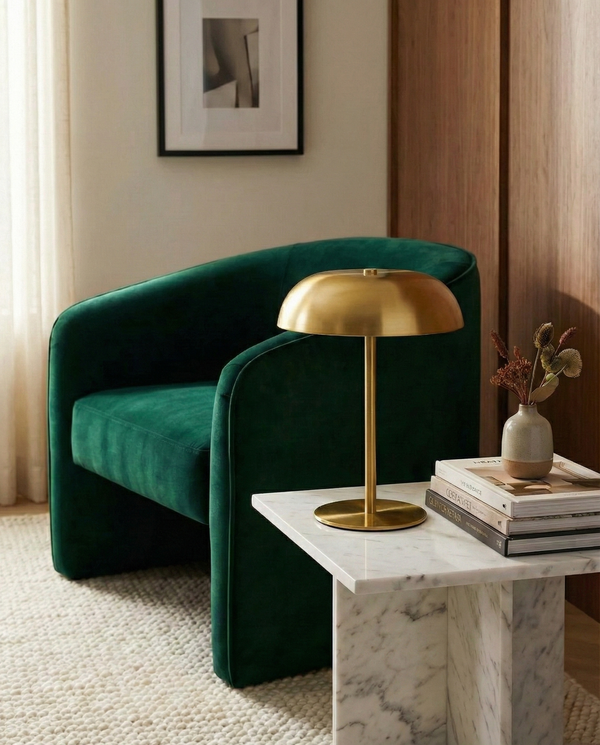
A small table lamp on the console, a discreet string of lights, or a spot aimed at a picture. This is the layer that gives character. It's also the one you switch on first when coming home in the evening.
The corridor: creating rhythm through light
The trap with corridors: lighting them with a single point source. The result: a dark tunnel at each end.
The rule: spread the light out every 2-3 metres. Several small points are better than one big central ceiling light.
Possible solutions
- Recessed spotlights: 1 spot every 1.2 to 1.5 m. Contemporary, even rendering.
- Wall lights: every 2-3 m, alternated if the corridor is wide. Warmer than a ceiling light.
- Linear LED rail: designer solution, more complex installation but spectacular effect.
- Table lamps on a long console: easy solution if you have a long piece of furniture in the corridor.
A corridor seen as a design flaw can become an asset with the right lighting. The best corridors invite you to linger in them.
Our suggestions for hallway and corridor
Here are 3 Lumora models that work particularly well in these spaces.

Selora — Art Deco crystal ceiling light, Ø 23 cm
Cut crystal prisms that break the light into golden reflections. A compact 23 cm format designed for hallways, corridors and small spaces. E27 bulb not included.
- Ceiling light
- Cut crystal
- Ø 23 cm
- E27 fitting
- Gold finish

Banora — Hand-woven rattan pendant, 30 cm
A hand-woven natural rattan shade with organic patterns and shadow play, on a black ceiling fitting. A 30 cm format for hallways, corridors or dining nooks. E27 bulb not included.
- Pendant light
- Hand-woven rattan
- 30 cm
- E27 fitting
- Bohemian style

Verora — Fluted glass and rattan wall light
Our best-selling wall light: finely fluted clear glass on a warm frame, designed like a piece of wall jewellery that creates an intimate atmosphere as night falls.
- Wall light
- Fluted glass
- Rattan
- Grey or gold finish
The 4 solutions by configuration
Narrow hallway with a low ceiling
Forget the pendant (it would crush the space). Go for a flat LED ceiling light + a wall light near the mirror. Simple, effective.
Spacious hallway with a high ceiling
The ideal playground for a statement pendant (cluster, contemporary chandelier). Complete with 2 table lamps on the console to soften the mood in the evening.
Long, narrow corridor
Alternating wall lights every 2-3 m. Or a recessed spot rail for a modern linear effect. Avoid a single central point source.
Hallway opening directly onto the living room
The risk: two lighting schemes that clash with each other. Harmonise the colour temperatures (everything in 3000K warm) and favour dimmers on both the hallway and living room so you can modulate them together.
Styles and ambiences for your decor
| Style | Suggestion | Temperature |
|---|---|---|
| Scandinavian minimalist | White / matt brass pendant, simple wall light | 3000K |
| Contemporary chic | Ledora + designer wall light, recessed spots | 3000K-4000K |
| Boho / natural | Rattan pendant, terracotta lamp | 2700K |
| Industrial | Black metal wall light, exposed filament bulb | 2700K |
| Art deco / classic | Gold chandelier, vintage wall light | 2700K |
Frequently asked questions
How many light points in a 6 m corridor?
Minimum 3: one at each end and one in the middle. Ideally 4 to avoid dark spots. For recessed spots, allow 1 spot every 1.2-1.5 m.
What colour temperature in a hallway?
2700K to 3000K (warm white). It's the most welcoming temperature and best showcases your decor. Avoid 4000K+, which makes the space feel cold.
Can you install a motion sensor in the hallway?
Yes, very practical for the general lighting: it switches on as soon as you come in. Be sure to set the switch-on duration correctly (30-60 s ideal) and don't apply it to the decorative lighting.
Do you need a dimmer in a hallway?
Highly recommended. The hallway needs to be brightly lit in the morning (getting ready) and soft in the evening (coming home from work). A dimmer handles this wide range.
Is a wall light alone enough in a small hallway?
Not ideal. A wall light illuminates one side, leaves the other in shadow. In a small hallway, combine: flat ceiling light + 1 wall light near the mirror minimum.
Conclusion: 3 principles to remember
- Never a single light point — always at least 2 layers (general + accent)
- Warm, not cool — 2700-3000K for the hallway and corridor
- Rhythm in a corridor — lighting every 2-3 m minimum
Hallways and corridors are the great forgotten spaces of home lighting. Giving them proper care means turning these transit zones into genuine rooms in their own right.
The Lumora team's take
The investment with the greatest emotional return: a touch-sensitive table lamp on the hallway console. You switch it on as you come home in the evening, before you've even taken off your coat. That little welcoming light transforms how you feel about your home. Try it, and you won't be able to do without it.


