


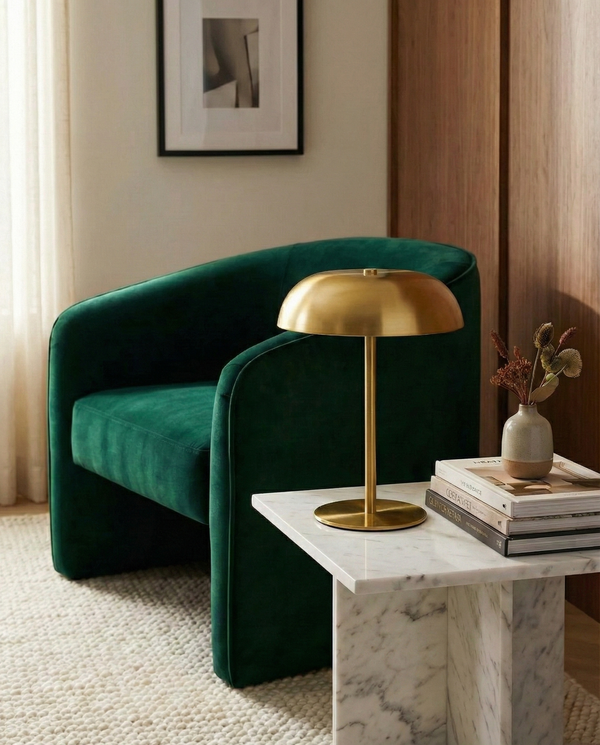

Step into a luxury hotel, a Michelin-starred restaurant or a high-end spa. What do you notice? You don't see any light source directly. No dazzling ceiling light, no aggressive spotlight. And yet, the space is perfectly lit. That's the magic of indirect lighting — light that reflects off surfaces rather than striking your eyes.
Ready to shop? Discover our floor lamps — 7 designs curated by Lumora.
This technique, long reserved for professionals and interior architects, is now accessible to everyone. Without heavy works, without complex wiring, with the right light fixtures and a few simple principles, you can transform your interior into a space worthy of a design magazine.
What exactly is indirect lighting?
Indirect lighting is any light that reaches your eyes after bouncing off a surface: a wall, a ceiling, a pale floor. Unlike direct lighting (spotlight, ceiling light, desk lamp) which projects light straight toward the area to be lit, indirect uses the surrounding surfaces as reflectors.
The result is fundamentally different:
- Direct lighting — Concentrated light, pronounced shadows, strong contrast. Ideal for precise tasks (reading, cooking, working).
- Indirect lighting — Diffused light, soft shadows, enveloping ambience. Ideal for relaxation, atmosphere and architectural enhancement.
Indirect lighting doesn't replace direct lighting — it complements it. The best interiors combine both intelligently.
The major techniques of indirect lighting
Wall washing
The flagship technique of interior architects: a uniform sheet of light is projected along a wall. The effect is spectacular — the wall seems lit from within, textures are revealed, the room appears larger.
This effect is achieved with wide-beam wall lights angled upward, or with LED strips recessed behind a suspended ceiling. The key: placing the source far enough from the wall (15-30 cm) for the light to spread evenly without creating a hotspot.
Uplighting
A light fixture placed on the floor or on a piece of furniture projects its light toward the ceiling, which redistributes it throughout the room. It's the simplest technique to implement — a single uplighter floor lamp in a corner is enough to transform the ambience of a living room.
The ceiling must be pale (white or cream) for the reflection to be effective. A dark ceiling will absorb the light instead of redistributing it.
Cove lighting
LED strips are concealed in a cornice, a ceiling recess or behind furniture. The light projects toward the ceiling or wall without the source being visible. It's the height of elegance — light seems to emanate from the architecture itself.
Cove lighting generally requires works (creating a light trough or a suspended ceiling). But there are alternatives without works: adhesive LED profiles that you stick to the top of a tall piece of furniture or behind a headboard.
Backlighting
The light source is placed behind an object or piece of furniture: behind a mirror, under a TV unit, behind a headboard. The object stands out from the wall with a luminous halo that creates depth and a floating effect.


The concrete advantages of indirect lighting
Reduction of glare
Glare is the enemy of visual comfort. It causes eye strain, headaches and general discomfort. Indirect lighting eliminates this problem at the source: since the light is reflected, it reaches your eyes with reduced intensity and uniform distribution.
Creating depth
Lighting that is only direct flattens space. Everything is lit the same way, without relief. Indirect creates gradients of light — brighter zones that gradually blend into darker zones. That's what gives an interior the sense of depth and volume that magazine photographs seek.
Highlighting architecture
Do you have a beautiful stone wall, exposed beams, a decorative niche? Indirect lighting elevates them. Wall washing reveals every texture, every relief. Grazing light transforms a plain wall into an architectural element.
Calming ambience
Science confirms it: indirect warm white light encourages the production of melatonin and prepares the body for rest. That's why high-end hotel rooms almost systematically banish ceiling lights in favour of indirect lighting.
Combining direct and indirect lighting: the rule of 3 layers
Interior architects always work with three layers of light:
- Ambient light (indirect) — The general lighting of the room, soft and uniform. Uplighters, LED cornices, wide-beam wall lights.
- Functional light (direct) — For specific tasks: reading, cooking, working. Desk lamps, adjustable spotlights, reading lamps.
- Accent light (mixed) — To highlight an object, a painting, a plant. Directional spotlights, display lighting, backlighting.
The key is being able to switch each layer on and off independently. In the morning, you need the functional layer (getting ready, reading). In the evening, the ambient layer creates the atmosphere. To entertain, the three layers together — each set to the right intensity — create a restaurant-like ambience.
Room-by-room guide
The living room
The living room is the ideal room for indirect lighting. Place an uplighter floor lamp in a corner for ambient light. Add one or two wall lights for wall washing on the main wall. Complete with table lamps for functional reading light.
The bedroom
Banish the central ceiling light. Opt for wall lights on either side of the bed with an upward beam, combined with direct-beam bedside lamps for reading. An LED strip behind the headboard creates a spectacular backlighting effect.
The dining room
Here, it's the combination that makes everything. A pendant light above the table for direct lighting of the food. Wall lights or a floor lamp for the indirect ambience around. The dimmer is essential for shifting from family dinner to candlelit dinner.
The hallway and entrance
Circulation spaces are perfect for pure indirect lighting. Wall lights with up-and-down beams create a luminous rhythm along the wall. The effect is both practical (you see where you walk) and aesthetic (each wall light draws a shape of light on the wall).


Our selection for indirect lighting
Three Lumora light fixtures particularly suited to indirect lighting, each with a different technique.

Hitora — Wabi-sabi floor lamp, 2,000 lumens upwards
A hand-knitted fabric shade that sends up to 2,000 lumens upwards, for generous indirect lighting. 175 cm tall, E27 LED bulb included.
- Floor lamp
- Hand-knitted fabric
- Up to 2,000 lumens
- E27 LED bulb included
- Height 175 cm

Sabora — Wabi-sabi floor lamp, dual diffusion
A solid wood base with natural grain, brushed nickel finish and a textured fabric shade. 249 to 2,000 lumen LED with dual diffusion, upwards and downwards. 155 cm tall, bulb included.
- Floor lamp
- Solid wood
- 249 to 2,000 lumens
- Up and down diffusion
- Height 155 cm

Verora — Fluted glass and rattan wall light
Our best-selling wall light: finely fluted clear glass on a warm frame, designed like a piece of wall jewellery that creates an intimate atmosphere as night falls.
- Wall light
- Fluted glass
- Rattan
- Grey or gold finish
DIY tips for indirect lighting without works
There's no need to knock down walls to enjoy indirect lighting. Here are quick, reversible solutions:
- Lamp behind a plant — Place a small table lamp behind a large leafy plant. The light filters through the leaves and creates organic shadows on the wall.
- LED strip behind the TV unit — Stick an adhesive LED strip (warm white, 2700K) behind your TV unit. The backlighting reduces eye strain and transforms the wall.
- Floor lamp in a corner — Simply place an uplighter floor lamp in a corner of the room. The ceiling redistributes the light naturally.
- Mirror + lamp — Place a table lamp in front of a large mirror. The mirror doubles the luminous effect and visually enlarges the room.
- Backlit shelving — An LED strip stuck under each shelf projects a soft light onto the objects displayed below. Art gallery effect guaranteed.
Frequently asked questions about indirect lighting
Is indirect lighting enough to light a room?
On its own, indirect lighting creates a magnificent ambience but is insufficient for tasks that require precision (reading, cooking, working). Ideally, you should combine it with functional direct lighting — a reading lamp, a kitchen spotlight — to get the best of both worlds.
Which type of bulb for indirect lighting?
Favour warm white (2700-3000K) for ambient indirect lighting. Warm light reflected on a cream white wall gives an enveloping rendering. In cool white, the effect is more clinical — reserve this for work areas.
Does indirect lighting use more energy?
Not necessarily. Reflection absorbs roughly 30% of the light (depending on the colour and texture of the wall). But since indirect lighting eliminates glare, you don't need as many lumens as with direct lighting. Modern LEDs largely compensate for this loss from reflection.
Do I need a white ceiling for uplighting?
White or cream is ideal. A pale ceiling reflects 70 to 85% of the light it receives. A dark grey ceiling reflects only 20 to 30%. With a dark ceiling, favour wall washing (light on the walls) rather than uplighting.
Transform your interior with indirect light
Indirect lighting is probably the most underestimated decorating lever. With a single uplighter floor lamp or a pair of wall lights, you can fundamentally change the atmosphere of a room — without works, without paint, without new furniture.
Start simple: a living room corner, a hallway, behind the bed. You'll be surprised at the difference.
See the full Lumora collection →
Free shipping to mainland France. Free returns within 30 days. Secure payment.
The Lumora team's verdict
To get started with indirect lighting, the Galora is our first choice. A single uplighter floor lamp in a living room corner immediately transforms the ambience. For hallways and bedrooms, a pair of Halora creates a luxury hotel effect without any works.


