



The kitchen is the most heavily used room in the home — and paradoxically the most poorly lit. Too many households make do with a single central ceiling light that leaves the worktop in shadow and extinguishes any ambience come evening. Yet good kitchen lighting plays out across 4 distinct zones, each with its own specific role.
In our shop, explore our pendant lights — 10 designs curated by Lumora.
In this guide, we break down how to structure light for a kitchen that is both functional by day and warm at dinner time.
1. General lighting: the foundation that lights the whole room
This is the primary lighting, the one that lets you move around and work everywhere. It must be powerful and uniform.
What power should you aim for?
We recommend between 300 and 500 lumens per m². For a 12 m² kitchen, that works out to 3,600 to 6,000 lumens — the equivalent of 3 to 5 LED bulbs of 10W.
Which solution should you choose?
- Flat LED ceiling light — minimalist, uniform, ideal for small kitchens
- Recessed spotlights — for a contemporary look (1 spot every 1.2 m)
- Adjustable spot rail — flexible if you change the layout
Favour a neutral white (4000K) colour temperature for the main ceiling light. Warm white is too cosy for working, cool white is too clinical.


2. Worktop lighting: safety and precision
This is THE critical zone. Without dedicated lighting, you work in your own shadow. Mishandled knives, poorly cut vegetables, eye strain.
The golden rule: under the wall units
Install LED under-cabinet strips. They light the worktop directly with no cast shadow. Allow 400 to 600 lumens per linear metre.
Available options
- Slim LED strips with touch-sensitive switch — wired or wireless
- Adhesive LED strips — budget-friendly, position them set back
- Spotlights recessed into the splashback — premium, requires dedicated wiring
For kitchens without wall units (island, loft), favour low-hanging pendant lights or directional ceiling spots.
3. Decorative lighting above the island or table
This is the signature lighting. It brings character and defines the dining area. This is where you can indulge yourself on the design side.
Ideal height
The bottom of the light fixture should sit 75-90 cm above the surface. Too high, and the light disperses. Too low, and it obstructs the view.
How many pendants?
- Island 80-120 cm: 1 large pendant, centred
- Island 120-200 cm: 2 pendants or 1 long linear fixture
- Island 200 cm and over: 3 pendants aligned, spaced 60-80 cm apart


For a harmonious effect, the pendants should be aligned with the centre of the island (not the width of the kitchen).
4. Ambience lighting: for the evening
This is the light you switch on after dinner. It transforms the kitchen into a welcoming living space.
The sources to combine
- Table lamp on the island — warm, 2700-3000K
- LED strip above the base units — indirect lighting
- Dimmer on the main lighting — lower the intensity in the evening
A kitchen that opens onto the living room must be able to switch into "lounge" mode. That is the role of ambience lighting.
Our Lumora suggestions for kitchen lighting
Here are 3 models perfectly suited to the different zones.

Sevora — Amber blown glass pendant
Amber blown glass that captures the warmth of a sunset. Mid-Century Modern in spirit, it comes in three shapes (cylinder, oval, sphere) and as a set of 3 for a table or island. E27 fitting.
- Pendant light
- Amber blown glass
- E27 fitting
- 3 shapes or set of 3

Verora — Fluted glass and rattan wall light
Our best-selling wall light: finely fluted clear glass on a warm frame, designed like a piece of wall jewellery that creates an intimate atmosphere as night falls.
- Wall light
- Fluted glass
- Rattan
- Grey or gold finish

Carora — Cordless mushroom lamp, 3 intensities
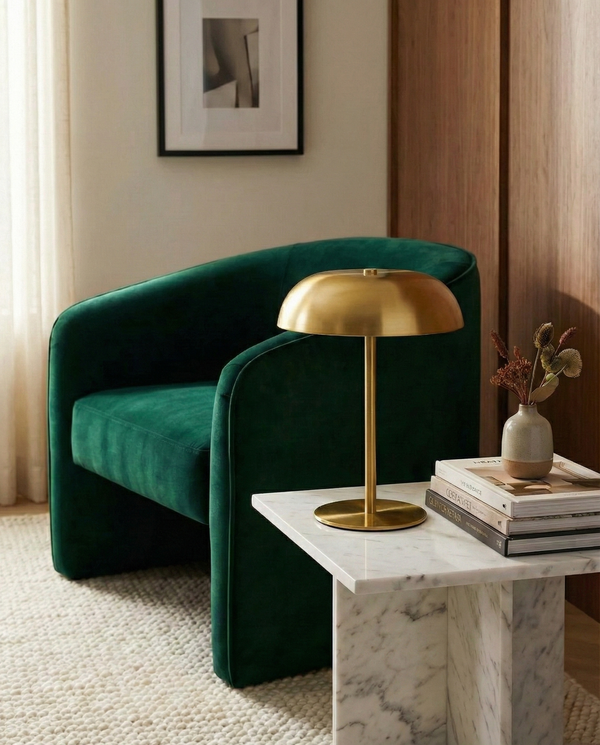
The iconic mushroom lamp in a touch-sensitive, cordless version: tap the top to switch on, three intensities (dim, reading, bright), USB-C charging and a matte finish. Cable included.
- Table lamp
- Touch activation
- 3 intensities
- USB-C rechargeable
- 4 colours
5 common mistakes to avoid
- A single central ceiling light — leaves you in shadow at the worktop
- Forgetting under-cabinet lighting — the most useful source day to day
- Cool white (6000K) everywhere — makes the kitchen feel clinical
- Pendants hung too high — beyond 90 cm, light disperses
- No dimmer — impossible to create a different ambience evening/day
Comparison: which lighting for which zone?
| Zone | Type | Power | Temperature |
|---|---|---|---|
| General | Ceiling light or spots | 300-500 lm/m² | 4000K |
| Worktop | Under-cabinet strips | 400-600 lm/m | 4000K |
| Island / table | Decorative pendant | 600-1000 lm | 3000K |
| Ambience | Table lamp / strip | 200-400 lm | 2700-3000K |
Frequently asked questions
What colour of light for a kitchen?
Task lighting: 4000K (neutral white). Decorative and ambience lighting: 3000K (warm white). Avoid 6000K.
Are recessed spotlights really necessary?
No. A flat LED ceiling light or a spot rail does the job perfectly well with no recessing work required.
How much does good kitchen lighting cost?
For a well-equipped 12 m² kitchen (ceiling light + under-cabinet + 2 pendants + 1 table lamp), budget €287-700 depending on the range.
Can you install low-hanging pendants with children around?
Yes, from 75 cm above the worktop. Avoid very thin glass if the island doubles as a breakfast table.
Are adhesive LED strips reliable?
Budget options: 2-3 years. Prefer LED strips certified to a minimum of IP20 from a recognised brand.
Conclusion: structure the light, don't pile it on
Good kitchen lighting isn't about multiplying lamps. It's about defining 4 zones and giving each one the lighting it needs. General lighting for working, worktop lighting for precision, decorative lighting for style, ambience lighting for the evening.
See the full Lumora collection →
Free shipping to mainland France. Free returns within 30 days.
The Lumora team's take
If you're only going to invest in one improvement, make it under-cabinet lighting. Modest budget (€46-100 for the kit), noticeable difference from the very first use.


