


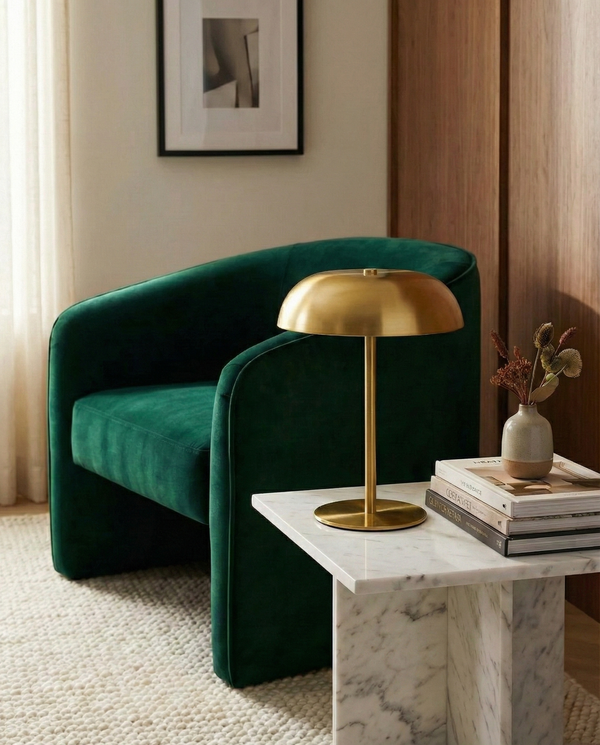

The floor lamp is the forgotten piece of lighting design. We think about the ceiling light, we take care over the bedside lamps, we invest in a beautiful pendant light — but the floor lamp? All too often relegated to the role of "a lamp on a stand placed in a corner". That's a mistake. A well-chosen, well-placed floor lamp transforms a living room as radically as a fresh coat of paint or a new sofa.
Ready to shop? Discover our floor lamps — 7 designs curated by Lumora.
This guide gives you everything you need to choose the perfect floor lamp for your living room: type, height, positioning, and above all how to integrate it into a coherent lighting plan.
The role of a floor lamp in a living room
The floor lamp is the Swiss Army knife of lighting. It's the only light fixture capable of:
- Lighting a whole room — an uplighter floor lamp can replace a ceiling light
- Creating a reading area — with an adjustable arm, it becomes a perfect reading lamp
- Sculpting the space — through its verticality, it structures a room and creates "columns of light"
- Moving around — unlike a ceiling light or a wall light, it needs no installation
A well-lit living room generally combines three layers of light: general lighting (ceiling light or indirect), accent lighting (spots, wall lights) and spot lighting (table lamps, reading lamps). A floor lamp can fill two of these three layers at once.
A floor lamp is to a living room what a handbag is to an outfit: a practical accessory that makes all the difference aesthetically.
The different types of floor lamp
The straight (or classic) floor lamp
A vertical shaft topped with a shade or a globe. It's the oldest and most versatile format. It diffuses light at eye level within a 2 to 3 metre radius. Ideal next to a sofa or an armchair.
The arc floor lamp
Its curved arm extends above a seat or a coffee table, creating overhead lighting without a ceiling light. The effect is spectacular and very on-trend. Careful: it needs a ceiling of at least 2.50 m and a clear space for the arm.
The tripod floor lamp
Three legs, a shade: the tripod brings a vintage, warm feel. Very prevalent in Scandinavian and bohemian interiors. Its wide base makes it stable but it needs more floor space than a slim-shafted floor lamp.
The uplighter floor lamp (indirect lighting)
The light is projected towards the ceiling, which reflects it throughout the room. It's the perfect alternative to a ceiling light when you can't (or don't want to) hang a pendant light. Indirect light is soft, shadowless and creates an enveloping ambience.
The reading floor lamp
Fitted with an articulated arm or a directional spot, the reading floor lamp focuses a precise beam on the reading area. Often combined with an uplighter: general lighting above, a reading lamp below. It's the most functional model.


The right height: rules and proportions
The standards to know
The ideal height of a floor lamp depends on its function:
- Ambient floor lamp: 150 to 180 cm. The shade should be above the line of sight when seated (around 120 cm). This avoids direct glare.
- Reading floor lamp: 120 to 150 cm. The light source must reach the shoulder height of a seated person to light a book or screen without casting a shadow.
- Arc floor lamp: 180 to 220 cm. The lowest point of the shade should remain at least 60 cm above the head of a seated person.
- Uplighter: 170 to 190 cm. High enough for the beam to reach the ceiling and diffuse evenly.
Adapting to ceiling height
The floor lamp must be in proportion to the room. In a living room with a standard 2.50 m ceiling, a 180 cm floor lamp leaves 70 cm of headroom — enough to breathe. With a 2.20 m ceiling (renovated older flat), limit yourself to 150-160 cm.
Conversely, in a loft with a 3 m ceiling, a 150 cm floor lamp will look squat. Go for a 190-200 cm model or an arc floor lamp that makes the most of the verticality.
Where to position your floor lamp: the 5 golden rules
1. Beside the sofa, not behind it
The floor lamp goes next to the armrest, slightly set back. Never directly behind the heads of seated people — this creates a glare zone and an annoying cast shadow on the TV screen.
2. Diagonally from the ceiling light
To avoid lighting redundancy, place the floor lamp in the opposite diagonal to your main light source. If your ceiling light is in the centre, the floor lamp goes in a corner. This creates a natural lighting balance.
3. Near a socket, away from a window
The cable must never cross a walkway. Place the floor lamp near a wall socket. Avoid positioning it in front of a window: during the day, it creates backlighting, and at night, the light is lost in the glazing.
4. As a space divider
In a large living room or a studio, a floor lamp can mark out two zones: reading nook vs TV corner, workspace vs relaxation area. Its verticality creates a visual boundary without partitioning.
5. In pairs or trios
A living room of more than 25 m² can accommodate two floor lamps. Placed in opposite corners, they create enveloping lighting and eliminate shadowy zones. For a large living area, combine an uplighter (general lighting) and a reading floor lamp (task lighting).


Our Lumora floor lamp selection
Five floor lamps for five different styles. All with built-in LEDs and carefully crafted finishes.
Ledora — Arc floor lamp, 249 to 2,000 lumens
A sculptural plated-aluminium arc with an integrated dimmable LED controlled by remote. 170 cm tall with a 120 cm reach, it sweeps over a sofa or reading corner.
- Arc floor lamp
- 249 to 2,000 lumens
- Dimmable
- Remote included
- Height 170 cm

Galora — Wabi-sabi floor lamp, up to 2,000 lumens
A hand-knitted fabric shade on solid wood and forged metal: a sculptural floor lamp giving up to 2,000 lumens, enough to cover 10 to 15 m². E27 LED bulb included.
- Floor lamp
- Hand-knitted fabric
- Up to 2,000 lumens
- For 10-15 m²
- E27 LED bulb included

Hitora — Wabi-sabi floor lamp, 2,000 lumens upwards
A hand-knitted fabric shade that sends up to 2,000 lumens upwards, for generous indirect lighting. 175 cm tall, E27 LED bulb included.
- Floor lamp
- Hand-knitted fabric
- Up to 2,000 lumens
- E27 LED bulb included
- Height 175 cm
Also discover the Salora and the Sabora to complete our floor lamp range.
Frequently asked questions about floor lamps
What height should a living room floor lamp be?
The ideal height depends on its use: 150 to 180 cm for ambience, 120 to 150 cm for reading, 180 to 220 cm for an arc floor lamp. The shade should always be above the line of sight of a seated person (around 120 cm).
Can a floor lamp replace a ceiling light?
Yes, an uplighter floor lamp (indirect lighting towards the ceiling) can replace a ceiling light. The ceiling acts as a reflector and diffuses the light throughout the room. It's actually more pleasant because indirect light is softer and shadowless.
Where should I place a floor lamp in a small living room?
In a reduced space, place the floor lamp in a corner next to the sofa. A slim model with a narrow shaft (base diameter less than 25 cm) takes very little floor space. Avoid tripods, which need more surface area.
What style of floor lamp for a modern living room?
For a modern living room, go for clean lines, brushed metal or matte black finishes and simple geometric shapes. Arc floor lamps or sculptural models bring a strong design touch. Avoid patterned fabric shades that date the decor.
The floor lamp: the ally of every living room
Whether straight, arc, tripod or uplighter, the floor lamp remains the most versatile light fixture in the living room. It needs no installation, moves at your whim and can fulfil the role of general lighting as well as that of a reading lamp. The key is to choose its height carefully, position it intelligently and integrate it into a multi-layered lighting plan.
Browse our complete floor lamp collection, all with built-in LEDs and considered design.
Free delivery in mainland France. Free returns within 30 days. Secure payment.
The Lumora team's view
For a contemporary living room, the Galora is our favourite: its sculptural presence and indirect lighting create an incomparable ambience. For reading, the dimmable Ledora is unbeatable. And for a natural touch, the Wabora in bamboo and linen.


