


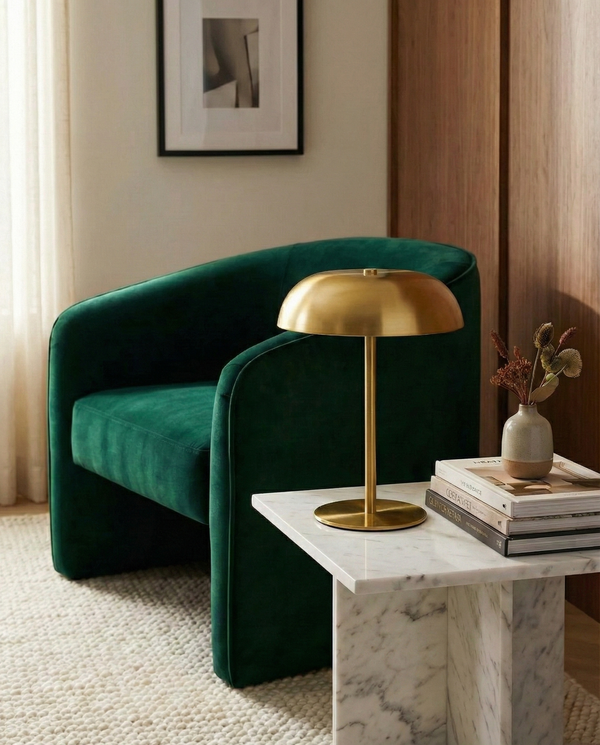

The living room is the most complex room to light. It's where we watch television, read, entertain friends and sometimes work. Each activity calls for different lighting — and yet most living rooms are lit in the same way: a single ceiling light and a few candles.
In our shop, explore our floor lamps — 7 designs curated by Lumora.
The result: flat, cold, soulless lighting. Here are the 7 most common mistakes and how to fix them to transform your living room.
Mistake No. 1: having only one light source
This is the most widespread and the most damaging mistake. A single ceiling light in the centre of the room produces flat, uniform lighting that erases volumes, creates harsh shadows under the eyes and offers no modulation.
The solution: multiply your sources. A well-lit living room has at least 3 light points:
- A general lighting source — ceiling light, pendant light or floor lamp (one that shines upwards)
- An ambient lighting source — table lamps, indirect LED strips, candles
- A task lighting source — reading lamp, directional spot on a specific area
This is the principle of the 3 lighting layers that every interior architect applies. We go into detail about it in mistake No. 3.
A well-lit living room is like an orchestra: you need several instruments playing together. A single ceiling light is a trumpet solo — it lacks nuance.
Mistake No. 2: choosing the wrong colour temperature
Have you installed "cool white" LED bulbs (5000-6500K) in your living room? Your living room looks like a hospital waiting room. It's not a question of lumens but of colour temperature.
The living room is a space for relaxation. The recommendation is clear:
- Warm white (2700-3000K) — for general lighting and ambience. It's the golden, warm tone reminiscent of candlelight.
- Neutral white (3500-4000K) — only for reading or working areas, if you work in your living room.
- Cool white (5000K+) — to be avoided in a living room, unless you run a dental surgery.
Ideally: lamps with several adjustable temperatures. Warm white in the evening, neutral during the day. It's versatility that makes the difference.


Mistake No. 3: not creating lighting layers
Designers talk about 3 levels of lighting that should coexist in a living room:
General (ambient) lighting
This is the basic "blanket of light". A floor lamp pointed at the ceiling, a dimmed ceiling light or indirect spots. It illuminates the entire room at a comfortable level (150-200 lux). Aim for around 2,000 to 3,000 lumens for this layer.
Accent lighting
This highlights an object, a painting or a shelf. Directional spots, LED strips under a piece of furniture, or a table lamp that lights up a corner of the room. This layer creates relief and depth.
Task (functional) lighting
Precise lighting where you need it: a reading lamp next to the sofa, a desk lamp if you work in the living room, a spot over the games table. Around 300-500 lux on the targeted area.
Mistake No. 4: installing light fixtures at the wrong height
A floor lamp that's too low dazzles. A pendant light that's too high lights the ceiling but not the room. Here are the right heights:
- Pendant light above a table — 70 to 80 cm between the bottom of the pendant and the tabletop
- Reading floor lamp — the shade at shoulder height when you're seated (around 120-140 cm from the floor)
- Wall lights — between 160 and 180 cm from the floor, that is, above eye level
- Table lamp on a piece of furniture — the shade at eye level in a seated position
Mistake No. 5: forgetting the dimmer
This is the most underestimated feature in residential lighting. Without a dimmer, your lamp has only two modes: on at full brightness or off. It's like a tap that only has "maximum flow" or "closed" settings.
The dimmer allows you to:
- Create a soft ambience for a film or a dinner
- Turn up the brightness for reading or working
- Adapt the lighting to the time of day — gentler in the evening, brighter in the morning
- Save energy — an LED at 50% uses almost 50% less energy
All our Lumora lamps include progressive touch dimming: a long touch continuously adjusts the intensity.


Mistake No. 6: ignoring task lighting
Reading on the sofa with just the ceiling light? Your book sits in the shadow of your own head. Working on your laptop with daylight creating reflections on the screen? Here's the problem: you don't have dedicated task lighting.
Every activity area in your living room deserves its own light source:
- Reading nook — a floor lamp or a directional reading lamp, 300-400 lumens on the book
- TV area — indirect lighting behind the screen (bias lighting) to reduce eye strain
- Desk corner — a desk lamp with 500 lux on the work surface
- Coffee table — an ambient lamp for drinks with friends
Mistake No. 7: cables everywhere
You have 4 lamps in the living room — and 4 cables snaking across the floor, behind the furniture, to the sockets. The visual result is disastrous, even with the most beautiful furniture in the world.
The solutions:
- Rechargeable cordless lamps — zero cable, zero placement constraint. It's the radical solution. Our Lumora rechargeable lamps last 8 to 12 hours.
- Decorative trunking — for wired floor lamps, trunking that matches the wall hides the cable.
- Strategic placement — place wired lamps near sockets, not on the opposite side of the room.
- Floor sockets — if you're building or renovating, plan for floor sockets in the centre of the room.
The right light fixtures for your living room
Here is our selection to correct these 7 mistakes and create magazine-worthy living room lighting.

Galora — Wabi-sabi floor lamp, up to 2,000 lumens
A hand-knitted fabric shade on solid wood and forged metal: a sculptural floor lamp giving up to 2,000 lumens, enough to cover 10 to 15 m². E27 LED bulb included.
- Floor lamp
- Hand-knitted fabric
- Up to 2,000 lumens
- For 10-15 m²
- E27 LED bulb included

Verora — Fluted glass and rattan wall light
Our best-selling wall light: finely fluted clear glass on a warm frame, designed like a piece of wall jewellery that creates an intimate atmosphere as night falls.
- Wall light
- Fluted glass
- Rattan
- Grey or gold finish
Herora — Blown glass, 3 colour temperatures
A blown-glass shade in soft tones, with variable intensity and three colour temperatures to move from reading to evening ambience. USB cable included.
- Table lamp
- Blown glass
- Variable intensity
- 3 colour temperatures
- USB cable included
Frequently asked questions about living room lighting
How many light fixtures should a living room have?
At least 3 light sources for a standard living room (20-30 m²). Ideally 4 to 5: general lighting (floor lamp or ceiling light), 2-3 ambient lamps (table lamps or wall lights), and 1 task light (reading lamp, desk lamp).
Should all the living room light fixtures match?
No — in fact, it's even inadvisable. Lighting that matches too closely produces a "furniture catalogue" look with no personality. Ideally: a common thread (same metallic finish, same colour family) but different shapes to create movement.
How do you light a living room without a ceiling light?
This is very common in older flats. The solution: a powerful floor lamp (1500-2000 lumens) that shines upwards to simulate general lighting, supplemented by table lamps and wall lights. The result is often more beautiful than with a ceiling light.
How can I reduce my living room lighting bill?
Three simple actions: replace all your bulbs with LEDs (consumption divided by 5 to 8), install dimmers (an LED at 50% uses almost 50% less), and switch off unnecessary lights — hence the value of having easy-to-access controls (touch, remote).
Well-lit living rooms change everything
Lighting is the No. 1 factor in a living room's ambience — ahead of furniture, ahead of wall colour, ahead of decoration. Well-thought-out lighting transforms an ordinary living room into a warm and welcoming space. And the good news: it's often the least expensive and most impactful change.
See our other guides: how many lumens per room, the ideal colour temperature, or perfect bedroom lighting.
See the entire Lumora collection →
Free delivery in mainland France. Free returns within 30 days. Secure payment.
The Lumora team's view
Our favourite combo for a living room: a Galora as general lighting, a Herora on the console for ambience, and a Ledora next to the sofa for reading. Three sources, three functions, zero visible cables thanks to being cordless.


