


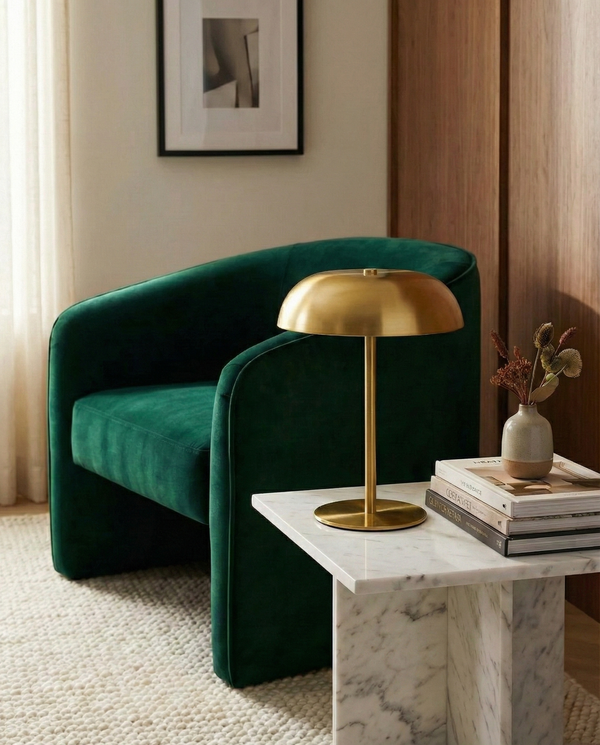

You buy a lamp, you look at the design, the price, the colour... but you forget the most important thing: how many lumens does it produce? Yet it is this figure that determines whether your room will be pleasantly lit or plunged into frustrating semi-darkness.
In our shop, explore our best-sellers — 8 designs curated by Lumora.
For decades, bulbs were chosen in watts. Today, with LEDs, that reference no longer makes sense. A 10-watt LED lights up as much as a 75-watt incandescent bulb. The only reliable indicator is the lumen.
Lumens, lux, watts: understanding lighting units
The lumen (lm): the quantity of light
The lumen measures the total luminous flux emitted by a light source. The higher the number of lumens, the brighter the source. It's the equivalent of a water flow rate: how much light comes out of the bulb each second.
- 100 lumens — a powerful candle, a night-light
- 400 lumens — ambient lighting, bedside lamp
- 800 lumens — equivalent of an old 60W bulb, good general lighting
- 1500 lumens — bright lighting, ideal for an office or kitchen
- 2000+ lumens — intense lighting, large spaces or professional lighting
The lux (lx): received light
The lux measures illuminance — that is, how much light reaches a given surface. 1 lux = 1 lumen per square metre. This is the unit that lighting standards use to define recommended levels.
The difference is crucial: a 500-lumen lamp in a 5 m² room gives 100 lux. The same lamp in a 25 m² room gives only 20 lux — insufficient to see clearly.
The watt (W): consumption
The watt measures only electrical consumption, not brightness. With LEDs, the watts/lumens ratio has radically changed:
| Lumens | LED (watts) | Incandescent (watts) | Saving |
|---|---|---|---|
| 400 lm | 4-5W | 40W | -90% |
| 800 lm | 8-10W | 60W | -85% |
| 1500 lm | 13-15W | 100W | -85% |
| 2000 lm | 18-20W | 150W | -87% |
Forget the watts when choosing your lighting. Remember the lumens: it's the only unit that truly tells you how much light you'll get.


How to calculate the lumens needed for your room
The formula is simple:
Lumens needed = Surface area (m²) x Recommended lux
For example, for a 20 m² living room with a recommended level of 150 lux:
20 x 150 = 3,000 lumens in total
Be careful: these 3,000 lumens don't necessarily need to come from a single fixture. In fact, that's not recommended. The ideal is to spread out the sources: a 2,000-lumen floor lamp + two 500-lumen accent lamps.
Factors that change the need
- Wall colours — white walls reflect 80% of the light, dark walls only 10-20%. A room with dark walls needs more lumens.
- Ceiling height — the higher the ceiling, the more the light disperses before reaching the floor.
- Age of the occupants — at 60, you need 2 to 3 times more light than at 20 for the same visual comfort.
- Natural light — a south-facing bay window considerably reduces the need for artificial lighting during the day.
Room-by-room recommendations
The living room (150-300 lux)
The living room is the most versatile room: you watch TV there (50 lux is enough), read there (300 lux minimum on the reading area), entertain friends. The solution: modular lighting.
For a 25 m² living room, aim for 3,750 to 5,000 lumens in total, spread between a main floor lamp, accent lamps and possibly indirect spotlights. The classic mistake: relying entirely on the ceiling light. The result: flat, featureless lighting.
The bedroom (100-200 lux)
The bedroom requires softer lighting. The aim isn't to see as in broad daylight, but to create a calming ambience that promotes sleep.
For a 14 m² bedroom: 1,400 to 2,800 lumens in total. In practice: a ceiling light or a pendant light of 1,500 lumens (rarely turned on) + two bedside lamps of 300 lumens each with a dimmer.
The kitchen (300-500 lux)
This is the room that needs the most functional light. Chopping vegetables, reading a recipe, checking how something is cooking — all of this requires precise and powerful lighting.
For a 12 m² kitchen: 3,600 to 6,000 lumens. The worktop needs a minimum of 500 lux. Combine general lighting (ceiling light or pendant) with spotlights under the wall units for the worktop.
The bathroom (200-300 lux)
Two distinct zones: general lighting (200 lux) and mirror lighting (400 lux minimum for applying make-up or shaving). Watch out: light fixtures must comply with IP standards for wet zones.
The office / workspace (300-500 lux)
European standard EN 12464-1 recommends 500 lux on the work surface for screen work. But beware: too much light creates reflections on the screen. Prefer indirect lighting + an adjustable desk lamp.


Summary table: lumens by room
| Room | Recommended lux | Example 12m² | Example 20m² |
|---|---|---|---|
| Living room | 150-300 lux | 1,800-3,600 lm | 3,000-6,000 lm |
| Bedroom | 100-200 lux | 1,200-2,400 lm | 2,000-4,000 lm |
| Kitchen | 300-500 lux | 3,600-6,000 lm | 6,000-10,000 lm |
| Bathroom | 200-300 lux | 2,400-3,600 lm | — |
| Office | 300-500 lux | 3,600-6,000 lm | 6,000-10,000 lm |
| Hallway | 100-150 lux | 1,200-1,800 lm | — |
| Dining room | 200-400 lux | 2,400-4,800 lm | 4,000-8,000 lm |
Our lighting sorted by luminous power
To help you choose the right light fixture based on your lumen needs, here's our selection.
Ledora — Arc floor lamp, 249 to 2,000 lumens
A sculptural plated-aluminium arc with an integrated dimmable LED controlled by remote. 170 cm tall with a 120 cm reach, it sweeps over a sofa or reading corner.
- Arc floor lamp
- 249 to 2,000 lumens
- Dimmable
- Remote included
- Height 170 cm
Galora — Wabi-sabi floor lamp, up to 2,000 lumens
A hand-knitted fabric shade on solid wood and forged metal: a sculptural floor lamp giving up to 2,000 lumens, enough to cover 10 to 15 m². E27 LED bulb included.
- Floor lamp
- Hand-knitted fabric
- Up to 2,000 lumens
- For 10-15 m²
- E27 LED bulb included

E27 8 W LED bulb — warm or cool white
Our E27 LED filament bulb: warm white for a golden, enveloping light, cool white for a more modern mood. Choose when adding to basket.
- LED bulb
- E27 fitting
- 8 W
- Warm or cool white
Frequently asked questions about lumens
Is 800 lumens enough for a living room?
No, not as a single source. 800 lumens corresponds to around 40 lux in a 20 m² living room, which is a very low lighting level. For a living room, you need 3,000 to 6,000 lumens in total, spread between several sources.
How many lumens to avoid tiring the eyes?
Visual fatigue doesn't only depend on lumens — it's mainly a question of contrast. Avoid excessive gaps between the lit area and the rest of the room. For an office, 500 lux on the work surface with ambient lighting of at least 200 lux around it.
Can you have too many lumens?
Yes. An excess of light creates glare and visual discomfort, especially in the evening. This is why the dimmer is essential: it allows you to adjust the lumens to the activity and the time of day.
Do lumens diminish over time?
Yes, this is luminous depreciation. An LED loses around 10 to 20% of its brightness after 25,000 hours of use. That's much better than incandescent (50% loss after 2,000 hours), but it should be taken into account for long-term installations.
Bespoke lighting, room by room
Lighting your home well doesn't mean installing the maximum lumens everywhere. It means understanding the needs of each room, adapting the intensity to the activity, and above all, being able to modulate. A good dimmer is worth more than five lamps.
Consult our other guides to go further: the 7 living room lighting mistakes, colour temperature by room, or ideal lighting for the bedroom.
See the whole Lumora collection →
Free shipping to mainland France. Free returns within 30 days. Secure payment.
The Lumora team's opinion
Our tip no. 1: never put just a single light fixture per room. Multiply the sources and install dimmers everywhere. Ledora with its 249 to 2,000 lumens is our best example of versatility — a single light fixture that adapts to every situation.


