


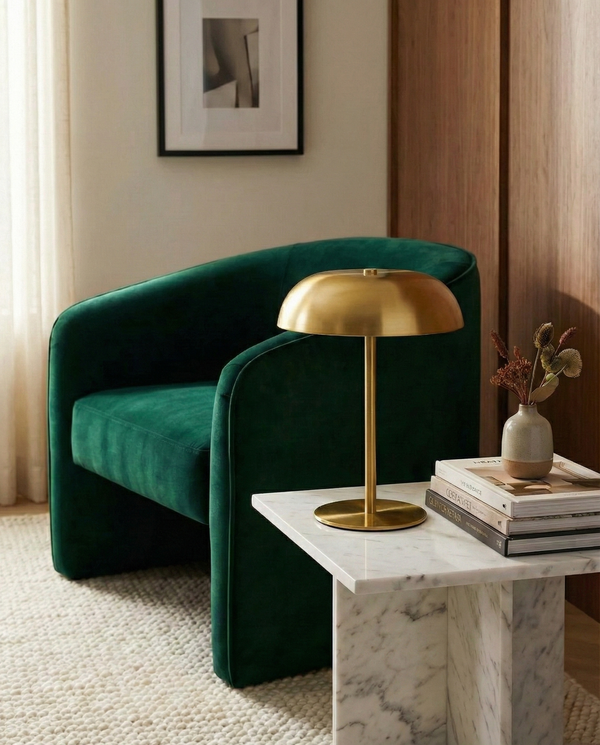

The hallway and the entrance are the two spaces where people almost always install too little light, and in the wrong place: a single ceiling light in the middle, leaving both ends in shadow. Yet the right number of lumens takes a minute to work out, and the real question is not "how many" but "spread how".
This guide is part of our series How many lumens per room. For layout ideas, see also hallway and entrance lighting.
Here are the levels to aim for, the formula, a chart by floor area from 2 to 12 m², and the spacing rule that turns a hallway into a welcoming passage.
The levels to aim for: a hallway and an entrance need different things
A hallway is a place you pass through: you do not read or work there. 100 to 150 lux is enough to move around easily and see where you step. An entrance asks for a little more, 150 to 200 lux, because you check yourself in a mirror, look for your keys and welcome people there.
These levels are much lower than a kitchen (300 to 500 lux) or a home office. That is normal: a hallway's goal is not to be bright, but to be even, with no dark patch from one end to the other.
The formula: lux × floor area
Lumens needed = floor area (m²) × recommended lux
A hallway 1 m wide and 5 m long is 5 m². At 120 lux it needs 5 × 120 = 600 lumens. A 6 m² entrance at 180 lux needs 6 × 180 = 1,080 lumens.
Two factors shift that result. Light walls bounce back a large share of the light and let you stay at the bottom of the range; dark walls or a dark floor absorb a lot and push you towards the top. And the higher the ceiling, the more the light scatters before it reaches the floor.
Chart: lumens by hallway and entrance floor area
| Space | Floor area | Target level | Total lumens | Recommended split |
|---|---|---|---|---|
| Small hallway | 2 to 3 m² | 100 to 150 lux | 200 to 450 lm | 1 ceiling light or 2 wall lights |
| 5 m hallway | 5 m² | 100 to 150 lux | 500 to 750 lm | 2 to 3 wall lights of 150 to 250 lm |
| 8 m hallway | 8 m² | 100 to 150 lux | 800 to 1,200 lm | 3 to 4 wall lights, or 2 ceiling lights |
| Small entrance | 4 m² | 150 to 200 lux | 600 to 800 lm | 1 ceiling light + 1 table lamp |
| Medium entrance | 6 m² | 150 to 200 lux | 900 to 1,200 lm | 1 pendant + 1 wall light + 1 table lamp |
| Large entrance | 12 m² | 150 to 200 lux | 1,800 to 2,400 lm | 1 pendant + 2 wall lights + 1 table lamp |
In a hallway, three well-spaced 200 lumen wall lights light better than one 800 lumen ceiling light in the middle: the total is similar, the feeling is nothing alike.
Spreading the light along the length
The hallway: one source every 2 to 2.5 m
The rule that changes everything: one wall light every 2 to 2.5 metres, all at the same height, 170 to 180 cm from the floor, starting about 1 metre from the beginning of the hallway. Each decorative wall light only needs 100 to 200 lumens: it is not the power that matters, it is the rhythm. Light aimed upwards makes the passage feel larger. For a 5 metre hallway, two to three wall lights are enough.
The entrance: three layers
A general level from the ceiling, a compact ceiling light or a pendant depending on the height: this brings most of the lumens. A wall light near the mirror or a picture to add depth. And a touch table lamp on the console, switched on as you come home in the evening before you even take off your coat: that is the welcome layer, not the useful one, and it is the one you remember.
The low ceiling
Under 2.40 m, a pendant crushes the space. Prefer a flat or compact ceiling light of 20 to 25 cm in diameter and a wall light near the mirror.
Warm white, and a dimmer
In a hallway as in an entrance, stay in warm white, 2,700 to 3,000 K. It is the most welcoming temperature, and the one that flatters the décor. A white of 4,000 K or more gives an entrance the feel of a utility room. If the entrance opens straight onto the living room, keep the same temperature in both spaces.
A dimmer is very useful here: the entrance should be crisp in the morning to get ready, and soft in the evening when you come home. A touch table lamp with several intensities plays that role with no wiring work.
The 4 classic mistakes
- A single light point in the middle of the hallway: the lumen total is right, the ends stay dark.
- Wall lights at different heights: the rhythm breaks, and the eye sees it immediately.
- Too many lumens in the entrance: 2,000 lumens for 4 m² dazzles, especially in the evening. The level to aim for stays at 150 to 200 lux.
- Cool white: the entrance is the home's first impression, not a waiting room.
Our selection for the entrance and hallway
Three fixtures whose product sheets target precisely these spaces: a compact ceiling light, a 30 cm pendant and our best-selling wall light.

Selora — Art Deco crystal ceiling light, Ø 23 cm
Cut crystal prisms that break the light into golden reflections. A compact 23 cm format designed for hallways, corridors and small spaces. E27 bulb not included.
- Ceiling light
- Cut crystal
- Ø 23 cm
- E27 fitting
- Gold finish

Banora — Hand-woven rattan pendant, 30 cm
A hand-woven natural rattan shade with organic patterns and shadow play, on a black ceiling fitting. A 30 cm format for hallways, corridors or dining nooks. E27 bulb not included.
- Pendant light
- Hand-woven rattan
- 30 cm
- E27 fitting
- Bohemian style

Verora — Fluted glass and rattan wall light
Our best-selling wall light: finely fluted clear glass on a warm frame, designed like a piece of wall jewellery that creates an intimate atmosphere as night falls.
- Wall light
- Fluted glass
- Rattan
- Grey or gold finish
Frequently asked questions about hallway and entrance lumens
How many lumens for a 5 metre hallway?
Between 500 and 750 lumens in total, for a width of one metre. Split them into two or three wall lights of 150 to 250 lumens, spaced 2 to 2.5 metres apart, rather than a single ceiling light.
How many lumens for a 6 m² entrance?
Between 900 and 1,200 lumens, i.e. 150 to 200 lux. For example a pendant or ceiling light of around 800 lumens, completed by a wall light and a table lamp.
Is an 800 lumen ceiling light enough for a hallway?
In quantity, yes for a 5 to 8 m² hallway. In quality, no if it sits alone in the middle: the ends will stay dark. Add at least one wall light at each end, or replace it with three wall lights.
What output for a hallway wall light?
100 to 200 lumens per wall light is enough, in warm white 2,700 to 3,000 K. The aim is a regular rhythm of light, not brightness.
Do you need a motion sensor in a hallway?
It is handy at night, provided it drives a weak source, around 100 lumens, so it does not dazzle. During the day and evening, keep normally switched lighting, on a dimmer if possible.
Hallway and entrance, in short
100 to 150 lux for the hallway, 150 to 200 lux for the entrance, the lux × m² formula for the total, then one source every 2 to 2.5 metres at the same height, in warm white. For the other rooms, see the whole series how many lumens per room.
Lumora's advice
Count the light points before you count the lumens. A hallway is judged at its ends, not in its middle.


