


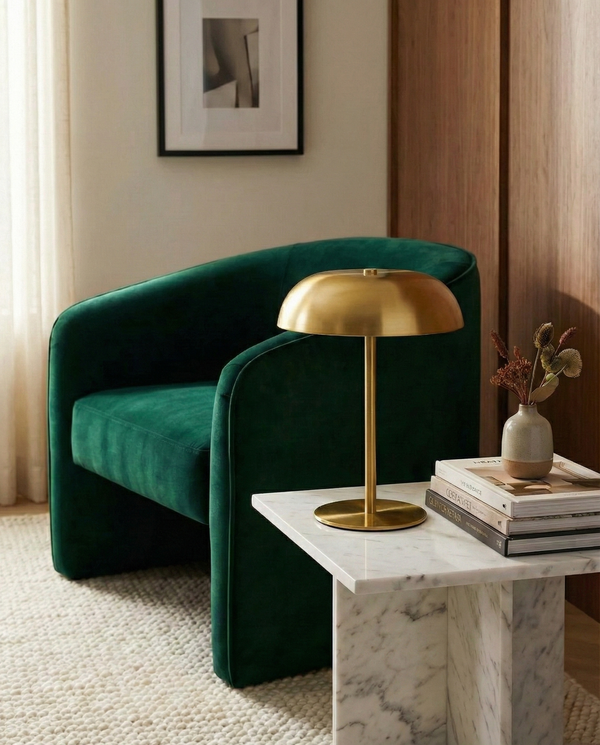

A bedroom needs fewer lumens than a kitchen, but its light directly impacts sleep quality. Too bright in the evening and your body doesn't secrete melatonin, so falling asleep drags. Too dim to read and your eyes tire. Understanding how many lumens for a bedroom isn't just about lighting — it's about preserving your biological rhythm.
Ready to shop? Discover our table lamps — 21 designs curated by Lumora.
This guide gives you the right lumen count, the breakdown by zones (general, bedside, dressing) and the critical colour temperature to respect so you don't disrupt your internal clock.
The basic rule: lumens per m²
A bedroom needs 100 to 150 lumens per square metre. The minimum in the home — even less than the corridor. Logical: you don't work there and comfort matters more than visual precision.
Concretely, a standard 14 m² bedroom needs 1 400 to 2 100 lumens total. Unlike the living room or kitchen, modularity matters less here: you have two clear phases, "wake/prep" and "wind down/sleep", to keep distinct.
The 3 zones of a bedroom
A well-planned bedroom has three independent lighting zones at different intensities.
1. General lighting (50 to 60% of total)
Central pendant or ceiling fixture, dimmable. Used for making the bed in the morning, finding a garment in the wardrobe, cleaning. Aim for 800 to 1 200 lumens in a 14 m² bedroom. Always dimmable: non-negotiable.
2. Bedside lighting (25 to 30% of total)
One or two bedside lamps (couple = two lamps mandatory). For nighttime reading without disturbing the partner. 200 to 400 lumens per lamp, in warm white. Our bedside lamp guide details the best models.
3. Accent and dressing lighting (15 to 20% of total)
Wall light above a dresser, adjustable spot near the wardrobe, or headboard wall light. Provides targeted complement. Count on 200 to 400 lumens in neutral white to distinguish clothing colours accurately.
A well-lit bedroom: three sources and one rule — everything must dim, except the dressing area.
Recap chart by area
| Bedroom type | Area | Total lumens | General | Bedside (each lamp) |
|---|---|---|---|---|
| Small | 9 to 12 m² | 900 - 1 800 | 500 - 1 000 | 200 - 300 |
| Standard | 13 to 16 m² | 1 400 - 2 400 | 800 - 1 200 | 250 - 350 |
| Large | 18 to 25 m² | 1 800 - 3 500 | 1 000 - 1 800 | 300 - 400 |
| Master suite | 30 m² and + | 3 000 and + | 1 800 and + | 400 and + |
Why temperature impacts your sleep
The colour temperature in a bedroom is non-negotiable. Above 3 000 K, light contains blue wavelengths that block melatonin production — the sleep hormone. The result: 30-45 extra minutes before you fall asleep.
Absolute evening rule: 2 700 K maximum, ideally 2 200-2 500 K in the late evening. For the biological details, our article on light and wellbeing goes deeper.
The morning is the opposite: a whiter light (3 500-4 000 K) helps you wake. Hence the value of bulbs with variable temperature (CCT) or having two distinct sources for morning and evening.
Mistakes to avoid
- A bedroom over-lit in the evening — If your bedroom exceeds 1 500 lumens at 100% in the evening, your sleep suffers. Always install a dimmer.
- Bedside lamps too bright — Above 400 lumens per lamp, it disturbs a partner already asleep. Stick to 200-300 lumens with precise orientation.
- 6 000 K LEDs in a bedroom — A fatal error. Replace any such bulbs with 2 700 K immediately.
- Forgetting the wardrobe zone — Without a wall light or spot near the dressing area, you pick clothes blindly. A 300-lumen neutral-white wall light does the job.
Our Lumora selection for the bedroom
A soothing bedroom calls for warm-light, dimmable luminaires with discreet design.

Belora — Rechargeable touch mushroom lamp
The touch-controlled mushroom lamp: tap the cap to change the intensity and switch between warm, neutral and cool light. Built-in battery, USB cable included.
- Table lamp
- Touch control
- 3 light tones
- Cordless rechargeable
- 8 colours

Aurora — Cordless lamp, 3,000 to 6,000 K
A 20 cm conical iron silhouette: three light temperatures, from warm white (3,000 K) to cool (6,000 K), and three intensities controlled with a touch. USB charging.
- Table lamp
- Cordless
- 3,000 to 6,000 K
- 3 intensities
- Height 20 cm

Wabora — Japanese floor lamp in knitted linen
Inspired by Japanese craftsmanship: a tall vertical band of light under a hand-knitted linen shade, for a woody, serene atmosphere. 120 cm tall, 11-15 W LED bulb not included.
- Floor lamp
- Hand-knitted linen
- Japanese style
- Height 120 cm
- Bulb not included
Frequently asked questions about bedroom lumens
How many lumens for a 14 m² bedroom?
Aim for 1 800 total lumens: 1 000 lumens general (dimmable pendant), 2 bedside lamps of 300 lumens each (warm white), and 200 lumens of wall light near the wardrobe.
Do I need a ceiling fixture in a bedroom?
Recommended but not mandatory if you have several accent sources. The ceiling fixture is mainly useful for cleaning and finding small items. A decorative pendant can replace it if it's dimmable.
What temperature for good sleep?
2 700 K maximum in the evening, ideally 2 200-2 500 K in the late evening. Above 3 000 K, you block natural melatonin production and take longer to fall asleep.
How many lumens for a bedside lamp?
200 to 400 lumens depending on use. For nighttime reading, 300 lumens directed at the book is plenty. Above that, it disturbs the partner and tires the eyes.
Do I need a dimmer in a bedroom?
Essential. Without a dimmer, you swing between "bright light" and "total darkness" — making the transition to sleep abrupt. A dimmer or touch-intensity lamps cost little and change the experience.
Lighting your bedroom properly in 2026
A well-lit bedroom respects two rules: never more than 3 000 K in the evening, and always a dimmer to adapt intensity to the moment. That's it. With this, your bedroom becomes a genuine recovery sanctuary.
To go further on bedroom atmosphere, see our complete bedroom lighting guide.
Free shipping. Free returns within 30 days. Secure payment.
The Lumora team's take
Our favourite bedroom setup: a Wabora pendant in warm 2 700 K (1 000 dimmable lumens) at the centre, two Belora bedside lamps with touch intensity (300 lumens each), and an Asiora wall light near the wardrobe (300 neutral lumens). In the evening, everything drops to 30%. In the morning, everything rises gradually. Your bedroom follows your biological rhythm, not the other way around.


