


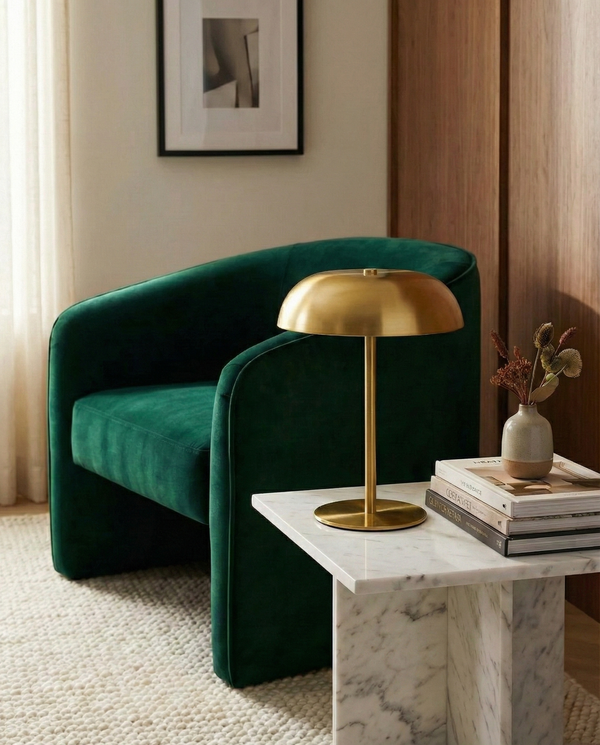

The kitchen is the room where lighting plays the most critical role in the home. Too dim, and you risk accidents while chopping vegetables. Too cold, and the atmosphere turns into a hospital cafeteria. The right number of lumens for a kitchen isn't a guess — it's calculated based on three precise criteria: area, use zones and colour temperature.
Want to go further? Discover our pendant lights — 10 designs curated by Lumora.
This guide gives you the exact method, a recap chart by size and our selection of luminaires tested for the kitchen. By the end, you'll know precisely how many lumens to install at home, without having to test blindly.
The basic rule: lumens per m²
A kitchen requires 300 to 400 lumens per square metre. That's about twice as much as a living room (150 to 200 lumens/m²) or a bedroom (100 to 150 lumens/m²). The reason: you handle sharp tools, read recipes, monitor cooking. Visual comfort isn't a luxury — it's a safety requirement.
This standard applies to LED lighting. If you're still using halogen or incandescent, the wattage figures no longer apply: think in lumens, never in watts. A quick look at our LED vs halogen vs incandescent comparison explains why.
Concretely: a 12 m² kitchen needs 3 600 to 4 800 lumens in total. But this total doesn't come from a single light source — it's spread across three distinct zones.
The 3 zones of a kitchen
The most common mistake: believing a single central ceiling light is enough. Wrong. You get light in the middle, but your body casts a shadow on the worktop the moment you bend over to chop something. The solution: layer three light sources.
1. General lighting (50% of total)
This is the background light, the one that lights the whole room evenly. Ceiling light, recessed spots or multiple pendants. It should represent about half of the total lumens. For a 12 m² kitchen needing 4 000 lumens, that's 2 000 lumens of general lighting.
2. Task lighting (30% of total)
This is the worktop lighting: under wall units, above the sink, near the hob. Without it, you work in your own shadow. LED strips under cabinets or adjustable wall lights. Allow around 30% of the total, so 1 200 lumens for our 12 m² kitchen.
3. Ambient lighting (20% of total)
This is the decorative and warming touch: pendants above the island, wall lights, accent lamps on a free worktop area. This layer transforms the functional kitchen into a living space. Given the ideal pendant height above an island (75-90 cm from the surface), we're talking about 800 lumens here.
A well-lit kitchen doesn't have a single light source — it has three, intelligently distributed.
Recap chart by area
Here's the summary chart by kitchen size. Values are in total lumens, to be split across the 3 zones.
| Kitchen type | Area | Total lumens | General (50%) | Task (30%) | Ambient (20%) |
|---|---|---|---|---|---|
| Small kitchen | 5 to 8 m² | 1 500 - 2 500 | 750 - 1 250 | 450 - 750 | 300 - 500 |
| Medium kitchen | 10 to 15 m² | 3 000 - 5 000 | 1 500 - 2 500 | 900 - 1 500 | 600 - 1 000 |
| Large kitchen | 20 to 25 m² | 6 000 - 8 000 | 3 000 - 4 000 | 1 800 - 2 400 | 1 200 - 1 600 |
| Open / American kitchen | 30 m² and more | 9 000 and more | 4 500+ | 2 700+ | 1 800+ |
To go further on other rooms, see our ultimate lumens-per-room guide.
The ideal colour temperature
Lumens and colour temperature are two distinct parameters. You can have the right number of lumens but an uncomfortable kitchen if the colour temperature in Kelvin is poorly chosen.
- Worktop — 4 000 to 5 000 K (daylight). This neutral temperature renders food colours faithfully and limits eye strain.
- General lighting — 3 000 to 4 000 K (neutral white). A good compromise between comfort and precision.
- Island or table ambience — 2 700 to 3 000 K (warm white). The cosy touch, perfect for dinners.
Ideally, your ambient luminaires are dimmable to switch between a functional kitchen (morning, prep) and a cosy one (dinner, evening coffee). Our complete light dimmer guide explains how to build in this flexibility.
Mistakes to avoid
Three classic traps found in 80% of kitchens:
- A single central ceiling light — You systematically work in your own shadow the moment you bend over the worktop.
- Forgetting under-cabinet lighting — The most-used area of the kitchen stays poorly lit. An LED strip under each wall unit changes everything.
- Going too cool (6 000 K and above) — The kitchen becomes hostile and clinical. You don't linger there, you use it and leave.
For typical mistakes in the adjacent living room (often connected to the kitchen in open plans), our article on the 7 mistakes to avoid when lighting a living room complements this nicely.
Our Lumora selection for the kitchen
All our models are dimmable and certified for kitchen use. Here are the three luminaires we recommend in priority.

Sevora — Amber blown glass pendant
Amber blown glass that captures the warmth of a sunset. Mid-Century Modern in spirit, it comes in three shapes (cylinder, oval, sphere) and as a set of 3 for a table or island. E27 fitting.
- Pendant light
- Amber blown glass
- E27 fitting
- 3 shapes or set of 3

Verora — Fluted glass and rattan wall light
Our best-selling wall light: finely fluted clear glass on a warm frame, designed like a piece of wall jewellery that creates an intimate atmosphere as night falls.
- Wall light
- Fluted glass
- Rattan
- Grey or gold finish

Noara — Mirror-finish mushroom lamp, 3 moods
A mushroom silhouette in mirror-varnished metal: a short press on the base moves from warm to natural or cool white, a long press adjusts the intensity. USB-C rechargeable battery, 25 cm tall.
- Table lamp
- 3 colour temperatures
- Adjustable intensity
- USB-C rechargeable
- Height 25 cm
Frequently asked questions about kitchen lumens
How many lumens for a 12 m² kitchen?
Aim for around 4 000 lumens total, split across 3 sources: 2 000 lumens general (ceiling or pendants), 1 200 task lumens (under-cabinet, wall light above the sink) and 800 ambient lumens (island pendant, accent lamp).
Do I need a dimmer in the kitchen?
Yes, especially for ambient lighting. Morning coffee prep, cosy evening dinner: needs change. A dimmer lets you go from 100% to 30% intensity in one gesture, without changing the bulb.
Recessed spots or pendants above the island?
Both can work. Recessed spots are discreet and provide even lighting. Pendants add character and visually delineate the island. For a kitchen open to the living room, pendants dress the space better. For a small enclosed kitchen, spots free up the space.
Warm or cool light for cooking?
For prep and cooking zones: neutral to cool light (4 000-5 000 K) to clearly distinguish food colours. For ambience (island, table): warm light (2 700-3 000 K). Ideally, your ambient luminaires are dimmable to switch by occasion.
How many pendants above an island?
Allow one pendant every 80 to 100 cm. A 1.80 m island easily takes 2 pendants; a 2.50 m island needs 3. For exact installation height, see our ideal pendant heights guide.
Lighting your kitchen properly in 2026
The rule is simple: 300 to 400 lumens per square metre, distributed over three zones (general, task, ambient), with an appropriate colour temperature for each zone. It's this layering that turns a functional kitchen into a pleasant living space.
If you're equipping a new kitchen or renovating existing lighting, plan for the three layers from the start: a single ceiling light will always leave you in your own shadow. And don't forget the dimmer — it's what lets you switch between morning kitchen and evening dinner.
See all our pendants for the kitchen →
Free shipping. Free returns within 30 days. Secure payment.
The Lumora team's take
For a 10-15 m² kitchen, our winning combination: a 2 500-lumen ceiling light in neutral white, two Sevora pendants above the island for warm ambient light (1 500 cumulative lumens), and one Asiora wall light above the main worktop (1 200 direct lumens). This layering eliminates every shadow zone and lets you adapt intensity to the time of day — morning prep, evening dinner, coffee in between.


