


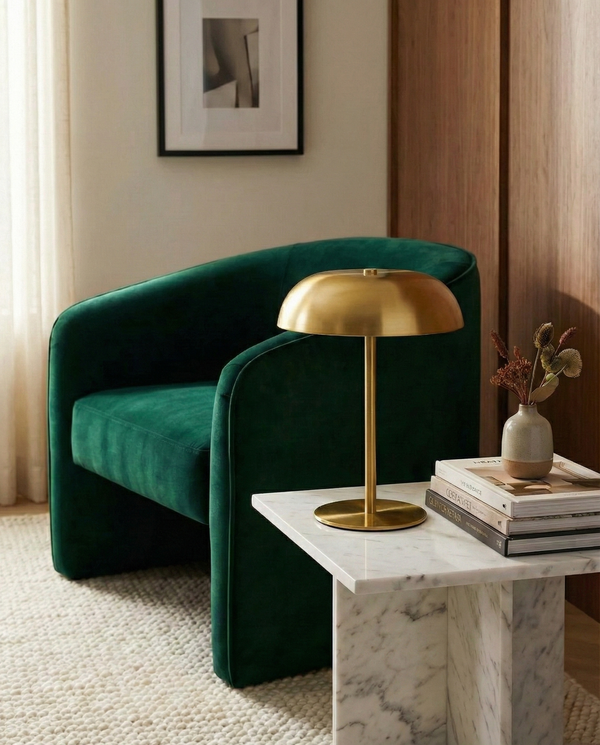

The living room is the most complex room to light in the home. Not because it demands lots of lumens — quite the opposite, it's actually the least demanding room in quantity — but because it has to simultaneously serve film-watching, book-reading, guest-hosting and cosy evening atmospheres. Four uses, four different lighting needs.
Looking for the right one? Browse our floor lamps — 7 designs curated by Lumora.
This guide gives you the method for calculating the right number of lumens for a living room, a chart by size, and the secret to switching from one mood to another without re-installing anything.
The basic rule: lumens per m²
A living room needs 150 to 200 lumens per square metre. That's half a kitchen (300-400 lumens/m²) but more than a bedroom (100-150 lumens/m²). The kitchen needs visual precision; the living room needs flexibility.
Concretely, for a standard 25 m² living room, that means 3 750 to 5 000 lumens total. But unlike other rooms, this figure must be modular: 100% in the evening for cleaning, 30% to watch a film, 60% to read in the armchair. That's why a single ceiling light is never enough.
The 4 functions of a living room
Thinking living-room lighting means thinking use scenarios. Four modes to plan for.
1. "Wind down / TV evening" mode
The dimmest. You want to see the screen without glare or harsh contrast with the surroundings. Allow 20 to 30% of total (so 800-1 200 lumens in our 25 m² living room) in indirect light behind the TV or in corners. The quintessential ambient lighting.
2. "Reading / activity" mode
Focused light on the armchair or sofa. A reading-arm floor lamp or accent lamp lighting the book directly without illuminating the whole room. Around 400 to 600 lumens dedicated to this zone.
3. "Hosting / hosting" mode
When guests are over. Lighting should enhance the space, highlight decor, create a warm atmosphere. 60 to 80% of total, spread across multiple sources (pendants, floor lamps, accent lamps).
4. "Tasks / cleaning" mode
100% of light. Main ceiling fixture on full + every other source. Rarely used but essential. Without a dimmer, this is the default mode — hence the importance of installing one.
A well-lit living room doesn't have one intensity — it has four, accessible in a single gesture.
Recap chart by area
Recap by living-room size. To be spread across at least 3 distinct light sources.
| Living room type | Area | Total lumens | Wind down / TV | Hosting |
|---|---|---|---|---|
| Small | 10 to 15 m² | 1 500 - 3 000 | 500 - 1 000 | 1 200 - 2 500 |
| Medium | 18 to 25 m² | 2 700 - 5 000 | 800 - 1 500 | 2 200 - 4 000 |
| Large | 30 to 40 m² | 4 500 - 8 000 | 1 400 - 2 500 | 3 600 - 6 500 |
| Cathedral | 50 m² and + | 7 500 and + | 2 200 and + | 6 000 and + |
For the master figure per room, see our ultimate lumens-per-room guide.
Ideal colour temperature
For a living room, stay warm. The ideal colour temperature is 2 700 to 3 000 K, warm white. This is the tone that makes the room welcoming and conducive to relaxation. Our complete colour temperature guide covers it all.
Avoid 4 000 K and above at all costs — it looks like office lighting and kills the mood. The only exception: the reading lamp, where 3 500 K can help distinguish text more easily without spoiling overall comfort.
Mistakes to avoid
Four recurring traps in living rooms:
- The solo central ceiling light — If that's your only source, your living room has two modes: "ON" and "OFF". No nuance. Add at least a floor lamp and an accent lamp.
- Forgetting the dimmer — A living room without a light dimmer can't adapt. It's the most worthwhile lighting investment.
- Going too cool — Above 3 500 K the atmosphere turns "waiting room". If you've got 4 000 K LEDs, swap them out.
- Aligning everything — Three lamps on the same wall don't create depth. Spread sources across corners for a layered effect.
For detailed mistakes with concrete examples, read the 7 mistakes to avoid when lighting a living room.
Our Lumora selection for the living room
Three luminaires that cover the four functions. All dimmable and dimmer-compatible.

Ledora — Arc floor lamp, 249 to 2,000 lumens
A sculptural plated-aluminium arc with an integrated dimmable LED controlled by remote. 170 cm tall with a 120 cm reach, it sweeps over a sofa or reading corner.
- Arc floor lamp
- 249 to 2,000 lumens
- Dimmable
- Remote included
- Height 170 cm

Verora — Fluted glass and rattan wall light
Our best-selling wall light: finely fluted clear glass on a warm frame, designed like a piece of wall jewellery that creates an intimate atmosphere as night falls.
- Wall light
- Fluted glass
- Rattan
- Grey or gold finish

Sevora — Amber blown glass pendant
Amber blown glass that captures the warmth of a sunset. Mid-Century Modern in spirit, it comes in three shapes (cylinder, oval, sphere) and as a set of 3 for a table or island. E27 fitting.
- Pendant light
- Amber blown glass
- E27 fitting
- 3 shapes or set of 3
Frequently asked questions about living-room lumens
How many lumens for a 20 m² living room?
Aim for around 3 500 total lumens, split across at least 3 sources: 1 800 lumens of general lighting (dimmable ceiling fixture), a 1 000-lumen floor lamp next to the armchair, and 2 accent lamps totalling 700 lumens in warm white.
Do I need a central ceiling light in a living room?
Not mandatory. If you have a tall floor lamp and several accent lamps covering the space, a ceiling fixture becomes redundant. It remains useful for "cleaning mode" (100% light) but can be replaced by a decorative pendant.
How many accent lamps in a living room?
For a 20-25 m² living room, plan for 2 to 3 accent lamps + 1 floor lamp + 1 central source (ceiling fixture or pendant). Total: 4 to 5 independent sources for real modularity.
What height for a pendant above a coffee table?
For a pendant above a living-room coffee table, allow 140 to 160 cm from the floor, meaning about 90-100 cm above the table. Taller than for a dining table. For full rules, see our ideal pendant heights guide.
Warm or cool light for a living room?
Always warm (2 700-3 000 K) for general atmosphere. The living room is for relaxation, not work. Cool light (4 000 K and above) kills the cosy mood.
Lighting your living room properly in 2026
The secret to a successful living room: multiple sources, warm (2 700-3 000 K), and a dimmer. With those three elements, your room shifts from "functional" to "cocoon" in a gesture — and you'll save on electricity by only powering what you need at any given moment.
If you're renovating your living-room lighting, install a wall dimmer first — even before choosing the luminaires. It's what truly unlocks your setup's potential.
See all our floor lamps for the living room →
Free shipping. Free returns within 30 days. Secure payment.
The Lumora team's take
For a 20 m² living room, our winning combination: a Verora floor lamp next to the sofa (1 000 lumens, dimmable), two Sevora pendants above the coffee table (1 500 cumulative lumens in warm white), and a Noara lamp on the entrance console (600 lumens). Total: 3 100 lumens distributed intelligently. You've got TV mode (Noara alone), reading mode (Verora alone), dinner-party mode (everything on 70%).


