


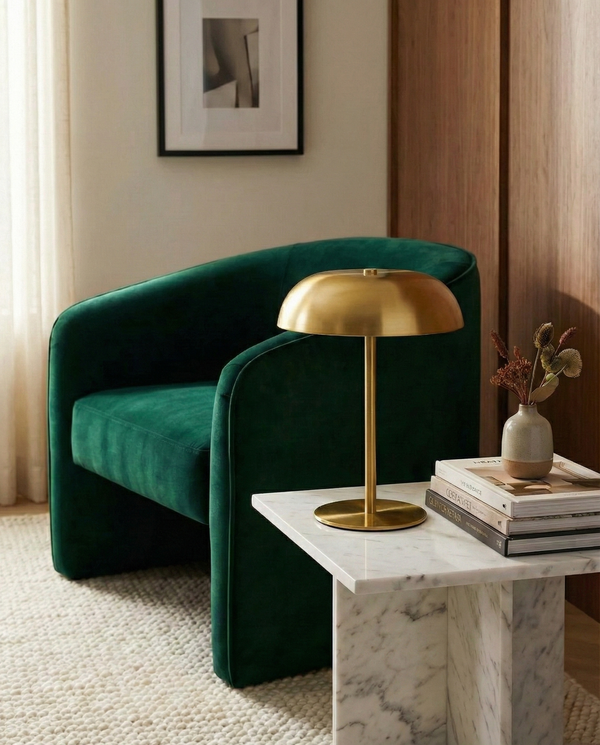

The mushroom lamp has been everywhere for two years now, and one finish stands out: polished silver. In interior photographs it is the one that catches the eye, the one that keeps turning up on moodboards. The success is not purely aesthetic: a mirrored surface genuinely changes how light behaves in a room. Here is why, and how to place one without the effect turning against you.
For the wider picture, see our reference on the mushroom lamp and its trends.
What the mushroom shape brings
Before the finish comes the silhouette. A closed dome on a short stem does one very simple thing that few lamps manage: it sends all the light downwards and lets none of it escape towards your eyes.
In practice you can set a mushroom lamp on a coffee table, at eye level when seated, and look straight at it without being dazzled. An open-shade lamp in the same spot shines directly into your eyes. That difference is why you find them so often on bedside tables and consoles.
A second consequence: the light forms a clean circle on the surface the lamp stands on. It lights a zone, not a room. It is an object for ambience and for corners, to be combined with a general source.
Why silver, specifically
A mirrored finish does more than decorate. It turns the lamp into a small reflector that bounces back its surroundings, and that has three concrete effects.
It brightens a dark corner without adding light. Polished metal picks up the ambient light of the room and redistributes it. Placed in a slightly dull corner, switched off, it stops that corner becoming a black hole. The same principle as a mirror facing a window, explained in our article on enlarging a room with light.
It is neutral. Gold warms, black absorbs, white recedes. Silver takes no side: it borrows the colour of whatever surrounds it. A beige living room will give it warm reflections, a blue-grey room cool ones. It is the easiest finish to slot into a scheme that already exists.
It changes through the day. A silver lamp does not have the same presence morning and evening. Switched off in daylight, it gleams. Lit at night, the dome darkens and only the pool of light on the table remains visible. Few decorative objects offer two faces this different.
Silver, gold, black or white: how to choose
| Finish | Effect in the room | Works with | Weak point |
|---|---|---|---|
| Polished silver | Reflects and brightens, neutral | Almost anything, warm or cool | Shows fingerprints |
| Gold | Warms, adds status | Wood, velvet, terracotta | Hard in a cool scheme |
| Matt black | Anchors, structures | Contemporary interiors, white | Disappears on dark furniture |
| White | Recedes, discreet | Everything, without imposing | Little presence |
| Bright colour | Accent point | Restrained schemes needing a lift | Dates faster |
If you are hesitating and your decorating is not settled, silver is the safest bet: it commits you to no palette at all.
Where to put it, and where not to
On a coffee table is the placement the shape was made for. The circular pool marks out a conversation area, and the silver picks up the light of the rest of the room.
On a bedside table, provided it offers several intensities. On its lowest setting a mushroom lamp makes an excellent late-evening light, contained and never dazzling.
On a hallway console, facing a mirror or a glazed door. That is where a mirrored finish gives most, visually doubling the object.
Two placements to avoid, on the other hand. Facing a cluttered space, because the dome faithfully reflects whatever sits in front of it: a pile of paperwork or a tangle of cables gets duplicated in miniature. And in a busy walkway, where a polished surface reveals every fingerprint.
The right light inside a mushroom
The dome hides the source completely: you cannot see the bulb, so you cannot judge the tone from outside. Two guidelines will keep you right.
First, favour a model with adjustable temperature over a fixed tone. An object in a living room or on a bedside table serves in warm light at night, but sometimes in the daytime too: being able to move from warm to neutral saves you choosing once and for all.
Second, intensity matters more than maximum output. An accent lamp you cannot dim ends up unused in the evening. Touch-controlled models solve this with no visible switch, as our guide to the touch lamp explains.
Finally, if the lamp needs to move between rooms through the day, a rechargeable model removes the socket constraint. Our reference on the cordless lamp compares runtimes and uses.
Caring for a mirrored finish
This is the one real drawback of polished silver, and it takes thirty seconds a week.
Dry microfibre cloth, lamp off and cold, in straight strokes rather than circles. Circular movements leave micro-scratches that show up in raking light.
Never glass cleaner or an abrasive on a lacquered finish: the lacquer goes dull and the damage cannot be undone. For a stubborn mark, a cloth barely dampened with clean water, then dried immediately with a second cloth.
Our full advice is in the lighting maintenance guide.
Our mushrooms in silver
Three models available in a silver finish, from the most accessible to the most refined, all rechargeable and adjustable.

Noara — Mirror-finish mushroom lamp, 3 moods
A mushroom silhouette in mirror-varnished metal: a short press on the base moves from warm to natural or cool white, a long press adjusts the intensity. USB-C rechargeable battery, 25 cm tall.
- Table lamp
- 3 colour temperatures
- Adjustable intensity
- USB-C rechargeable
- Height 25 cm

Carora — Cordless mushroom lamp, 3 intensities
The iconic mushroom lamp in a touch-sensitive, cordless version: tap the top to switch on, three intensities (dim, reading, bright), USB-C charging and a matte finish. Cable included.
- Table lamp
- Touch activation
- 3 intensities
- USB-C rechargeable
- 4 colours

Belora — Rechargeable touch mushroom lamp
The touch-controlled mushroom lamp: tap the cap to change the intensity and switch between warm, neutral and cool light. Built-in battery, USB cable included.
- Table lamp
- Touch control
- 3 light tones
- Cordless rechargeable
- 8 colours
Frequently asked questions about the silver mushroom lamp
Why is the mushroom lamp so popular?
Because its closed dome sends all the light downwards: you can place it at eye level without being dazzled, which makes it ideal on a coffee or bedside table.
Does silver work with a warm scheme?
Yes. A polished surface borrows the colour of its surroundings: in a room of wood and beige it returns warm reflections. It is the most neutral of the five finishes.
Does a mushroom lamp give enough light to read by?
Over a small area, yes, provided it sits close to the book. It is above all an ambient and accent lamp, to be combined with general lighting.
How do you clean a silver lamp without scratching it?
Dry microfibre cloth, straight strokes, lamp off and cold. No glass cleaner, no abrasive sponge, no circular movements.
Silver or gold for a mushroom lamp?
Silver if your scheme may still evolve or mixes several palettes; gold if you are committing to a warm dominant, with wood, velvet or brass already in place.
The silver mushroom lamp, in short
A shape that removes glare, a finish that returns the light of the room and suits every palette: that is the combination behind its success. Place it facing something worth reflecting, choose a model with adjustable intensity, and keep a microfibre cloth nearby. To explore the other shapes of the moment, our mushroom lamp trends reference covers the field.
The Lumora tip
Before settling on a final spot, crouch to seated height and look at what the dome reflects. You will choose the place not for the lamp itself, but for what it will show of the room.


