


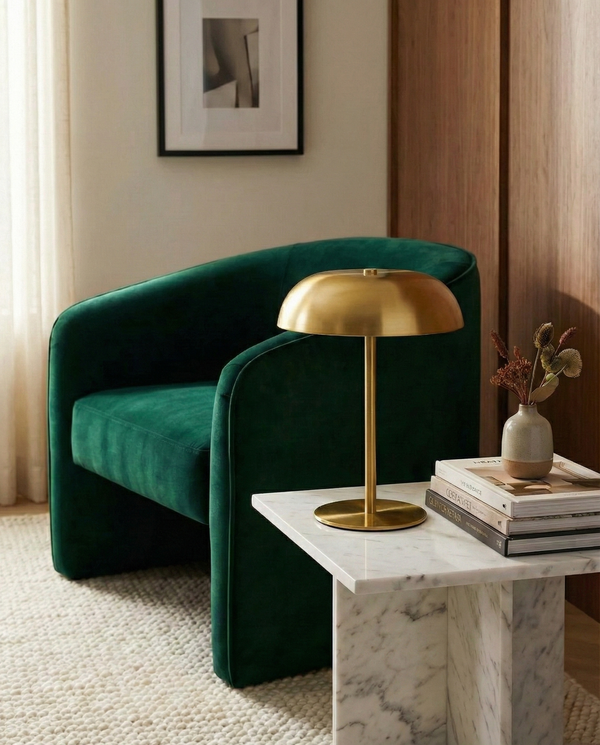

"How many watts for my bedroom?" is the question everyone asks, and it is the wrong unit. Since LED, the watt no longer measures light but consumption. A 10 W bulb can give as much light as an old 75 W one. The right question is "how many lumens", which you then translate into watts depending on the bulb type. For a 12 m² bedroom, here are both answers.
This guide completes our article on how many lumens for a bedroom and the lumens per room series.
The answer for 12 m²
A bedroom needs 100 to 150 lumens per square metre. It is the lowest level in the home: you do not work there, you rest. For 12 m², that gives 1,200 to 1,800 lumens in total, with every source switched on.
Translated into watts, depending on the bulb:
| Bulb type | Efficiency | For 1,200 to 1,800 lumens |
|---|---|---|
| LED | 80 to 150 lumens per watt | 12 to 18 W (based on 100 lumens per watt) |
| Halogen | 15 to 25 lumens per watt | 60 to 90 W |
| Incandescent (old bulb) | 10 to 15 lumens per watt | 100 to 140 W |
This is where intuition goes wrong: "100 watts for a bedroom" was true in the days of filament bulbs. With LEDs, the same light comes from 12 to 18 W in total, spread across several lamps.
The watts / lumens conversion table
To read a bulb box or replace an old one, here are the most useful equivalents. The marker to remember: 800 lumens = the old 60 W bulb.
| Lumens | LED | Incandescent | Use in a bedroom |
|---|---|---|---|
| 200 to 300 lm | 2 to 4 W | 15 to 25 W | Bedside lamp, strong night light |
| 400 lm | 4 to 5 W | 40 W | Ambient lamp, wall light |
| 800 lm | 8 to 10 W | 60 W | Ceiling light in a small bedroom |
| 1,500 lm | 13 to 15 W | 100 W | Ceiling light in a large bedroom |
| 2,000 lm | 18 to 20 W | 150 W | Too much for a bedroom on its own |
Forget watts when choosing. Remember lumens: it is the only unit that actually tells you how much light you get.
Spreading those lumens in a 12 m² bedroom
The total should never come from a single bulb on the ceiling. A bedroom lives in two moments, the morning to get ready and the evening to unwind, and each moment has its source.
The ceiling: 800 to 1,000 lumens, on a dimmer
A ceiling light or pendant, i.e. an 8 to 10 W LED. It is for making the bed, finding clothes, tidying. The dimmer is not optional: it is what lets you go down in the evening without changing lamps.
The bedsides: 200 to 300 lumens each
Two lamps, one per side of the bed, i.e. 2 to 4 W of LED each. Enough to read, not enough to disturb the person already asleep. Above 400 lumens per lamp, you disturb.
Optional: a wall light near the wardrobe, 200 to 300 lumens
A small targeted source to tell clothing colours apart, in a more neutral light than the rest.
The count for 12 m²: 900 lumens on the ceiling + 2 × 250 lumens at the bedsides + 250 lumens of wall light = 1,650 lumens, i.e. around 16 W of LED in total. Within the range, without forcing anything.
Colour matters more than watts
In a bedroom, colour temperature weighs more than power on sleep quality. In the evening, stay in warm white, 2,700 K or below: this light suppresses only around 15% of melatonin, versus 50% for a cool light. Bedside lamps with several temperatures allow a slightly more neutral light for reading, then a return to warm before sleep. To settle between the two warm whites, see 2700K or 3000K.
The 3 most common calculation mistakes
- Buying "100 W" in LED: a real 100 W LED would produce 10,000 lumens, five times too much for a bedroom. What you are looking for is "100 W equivalent", i.e. 13 to 15 real watts.
- Putting everything on the ceiling: 1,800 lumens in a single ceiling light dazzle in the evening and leave the bedsides without reading light.
- Comparing lumens across brands without looking at the colour: 800 lumens at 6,500 K and 800 lumens at 2,700 K have nothing in common in a bedroom.
Our bedside lamps to complete the ceiling
Two cordless lamps that cover the "bedside" share of the calculation, with several intensities and several light tones.

Belora — Rechargeable touch mushroom lamp
The touch-controlled mushroom lamp: tap the cap to change the intensity and switch between warm, neutral and cool light. Built-in battery, USB cable included.
- Table lamp
- Touch control
- 3 light tones
- Cordless rechargeable
- 8 colours

Aurora — Cordless lamp, 3,000 to 6,000 K
A 20 cm conical iron silhouette: three light temperatures, from warm white (3,000 K) to cool (6,000 K), and three intensities controlled with a touch. USB charging.
- Table lamp
- Cordless
- 3,000 to 6,000 K
- 3 intensities
- Height 20 cm
Frequently asked questions about watts in a bedroom
How many watts for a 12 m² bedroom?
12 to 18 W of LED in total, i.e. 1,200 to 1,800 lumens. In old incandescent bulbs, that corresponded to roughly 100 to 140 W.
How many watts for a 10 m² bedroom?
10 to 15 W of LED, i.e. 1,000 to 1,500 lumens: for example an 800 lumen ceiling light and two bedsides of 200 to 300 lumens.
How many watts for a 15 m² bedroom?
15 to 23 W of LED, i.e. 1,500 to 2,250 lumens, spread between a 1,000 to 1,200 lumen ceiling light, two bedsides and a wall light.
What output for a bedside lamp?
200 to 300 lumens, i.e. 2 to 4 W of LED, in warm white. Above 400 lumens, the lamp disturbs the person sleeping next to you.
A "60 W equivalent" LED bulb, how many lumens is that?
Around 800 lumens, for a real consumption of 8 to 10 W. It is the right size for the ceiling light of a small bedroom.
Watts and bedrooms, in short
For 12 m²: 1,200 to 1,800 lumens, that is 12 to 18 W of LED, spread between a dimmable ceiling light and two bedsides, in warm white in the evening. Read the lumens, not the watts, and to size the other rooms, see the how many lumens per room series.
Lumora's advice
On a bulb box, look for the lumens first, then the kelvins. Watts come last, and they only matter for the electricity bill.


